
Precision Reducing Bushings & Adapters
Eliminating Common Failures:
- Concentricity drift between bores
- Thread galling during assembly
- Leakage in hydraulic transitions
- Fretting at the step interface
- Wall thickness failure
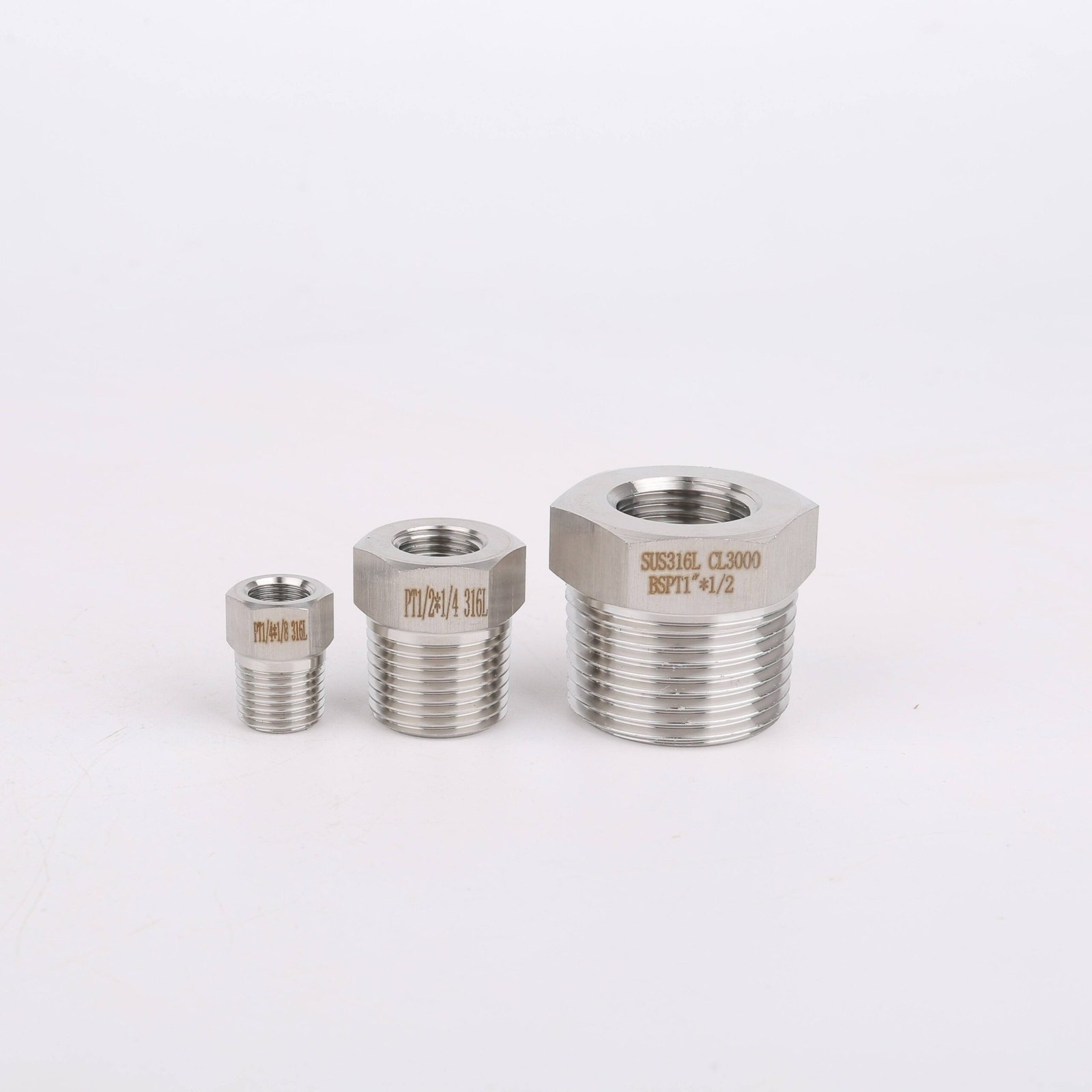
Where Generic Reducers Fail
Misalignment
Poor runout control between ID and OD causes shaft binding and vibration.
Leakage
Rough sealing faces or incorrect thread profiles lead to fluid bypass.
Fretting
Loose fits allow micro-motion, generating oxide debris and seizing parts.
Stress Cracks
Sharp corners at the step transition create stress risers under load.
Concentricity Control Strategy
Our Engineering Method
-
1
Single Setup Machining
We prioritize turning ID and OD in the same chucking operation to guarantee near-zero runout.
-
2
Datum Selection
Drawings are reviewed to establish the functional axis as the primary datum for all GD&T.
-
3
100% Runout Inspection
Critical reducers undergo total indicator reading (TIR) checks on precision mandrels.
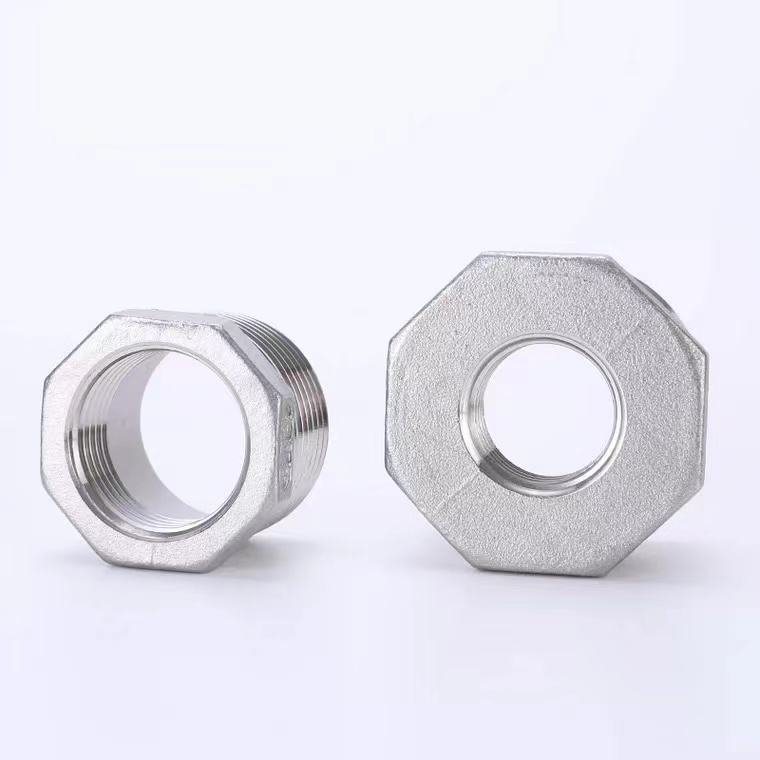
Geometry Configuration Options
Straight Step
Standard cylindrical reduction with a square shoulder. Ideal for press-fit stops.
Taper Transition
Conical transition zone to reduce stress concentration and improve flow dynamics.
Flanged Reducer
Combines reduction with a mounting flange for bolt-on retention.
Technical Specifications Matrix
| Parameter | Custom Capability / Standard |
|---|---|
| ID / OD Ranges | Machined to print (e.g., 50mm to 10mm reduction). No standard steps. |
| Step Length | Customizable to match housing depth or shaft engagement. |
| Runout / Concentricity | Standard: 0.05mm TIR. Precision: 0.01mm TIR (Per Requirement). |
| Thread Options | NPT, BSPP, BSPT, Metric, SAE, UNF (Internal/External). |
| Sealing Face | O-ring groove, Crush washer seat, Metal-to-metal conical seal. |
| Surface Finish | Ra 0.8µm – 3.2µm. Sealing faces to Ra 0.4µm. |
| Materials | Stainless (316/304), Brass, Carbon Steel, Aluminum, Plastics. |
| Coating Options | Passivation, Zinc Nickel, Anodize, Electroless Nickel. |
| Traceability | Heat code marking, material certs, dimensional reports. |
Manufacturing Process Controls
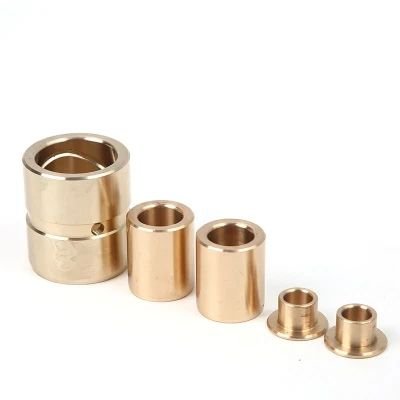
Soft Jaw Clamping
Custom bored soft jaws are used to grip thin-walled reducers without distortion or crushing.
Optimized Toolpaths
Turning strategies designed to minimize tool pressure and vibration on extended overhangs.
Burr Control
Automated chamfering and deburring cycles to ensure clean threads and smooth entry/exit.
Chamfer Standards
Consistent lead-in chamfers provided to aid assembly and prevent O-ring damage.
Applications & Interfaces
Critical Connection Points
- Hydraulic Adapters: High-pressure fluid transition.
- Fixture Tooling: Precision location of varying shank sizes.
- Pneumatic Housings: Air-tight bore reduction.
- Shaft Couplers: Mating dissimilar motor shafts.
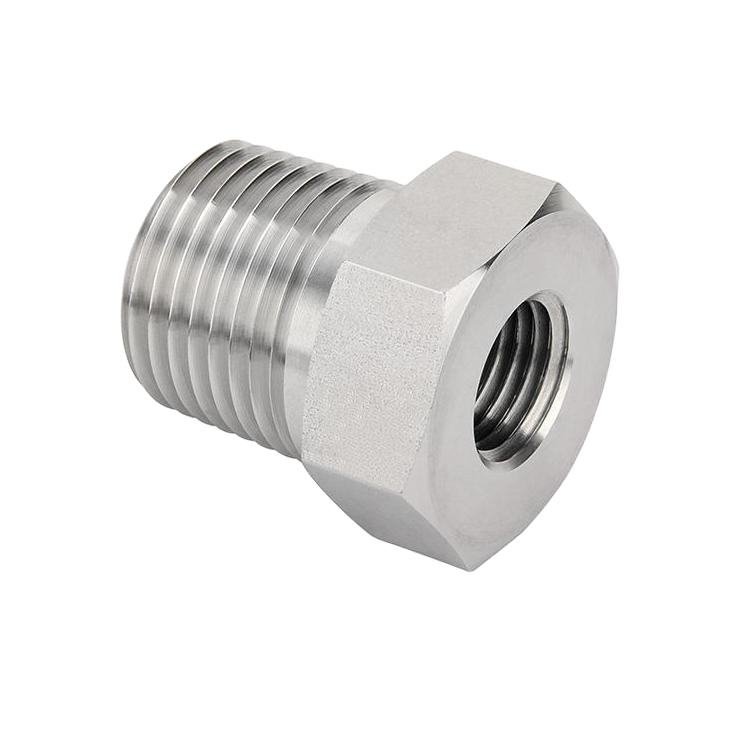
Quality Evidence Records
FAI Report
First Article Inspection report to AS9102 or custom format.
Material Certs
Full chemical and physical analysis from the mill.
Inspection Data
100% or AQL sampling dimensional data sheets.
Process Traveler
Documented routing and sign-offs for each production step.
RFQ Input Checklist
To ensure accurate quoting and manufacturing, please provide the following data points:
- 2D PDF Drawing
- 3D STEP Model
- Material Spec
- Quantity
| Data Needed | Why It’s Critical | Example |
|---|---|---|
| Concentricity Spec | Determines machining strategy (single vs double setup). | 0.02mm TIR A-B |
| Corner Radii | Affects stress concentration and mating fit. | R0.5 Max / Sharp |
| Surface Finish | Impacts sealing performance and friction. | Ra 0.8µm / 32µin |
Start Your Project
- Engineering Review included
- Material certification available
- Fast prototyping options
Reducing Bushing FAQ
What is your standard concentricity tolerance?
For general applications, we hold 0.05mm (0.002″) TIR. For precision requirements, we can achieve 0.01mm (0.0004″) TIR using single-setup machining.
Can you reduce threaded holes?
Yes, we manufacture threaded reducing bushings (adapters) with external and internal threads (e.g., M20 to M10, or NPT to BSPP).
How do you ensure leak-proof sealing?
We machine high-quality sealing faces (Ra 0.4-0.8µm) and can incorporate O-ring grooves or metal-to-metal conical seats per your design.
What materials do you recommend for corrosion resistance?
Stainless Steel 316 is best for harsh environments. For less severe conditions, Zinc-plated steel or Anodized Aluminum are cost-effective alternatives.
Can you make eccentric reducing bushings?
Yes, we can machine eccentric bushings where the ID is offset from the OD center, often used for adjustment or alignment correction.
What is the minimum wall thickness?
This depends on the material and diameter, but generally, we recommend a minimum wall of 1.0mm – 1.5mm to ensure structural integrity and machinability.
Do you provide inspection reports?
Yes, standard dimensional reports are available. We can also provide AS9102 FAI reports and material certifications upon request.
What is your lead time?
Typical lead time is 3-4 weeks. Expedited options are available. Stock material availability can influence these times.
Is there a Minimum Order Quantity (MOQ)?
We focus on custom manufacturing. While there is no strict MOQ, small runs (under 10 pcs) will have higher unit costs due to setup.
What files should I send?
Please send a 2D PDF with tolerances and a 3D STEP file. This ensures we quote accurately and machine exactly to your requirements.
Get Your Quote
Solve your alignment and fitment challenges today. Send us your specs for a professional engineering review.
info@rapidaccu.comOur Location
Rongli Industrial Park, Dalang
Longhua District, Shenzhen, China