
Engineering Handbook: Section 4.2
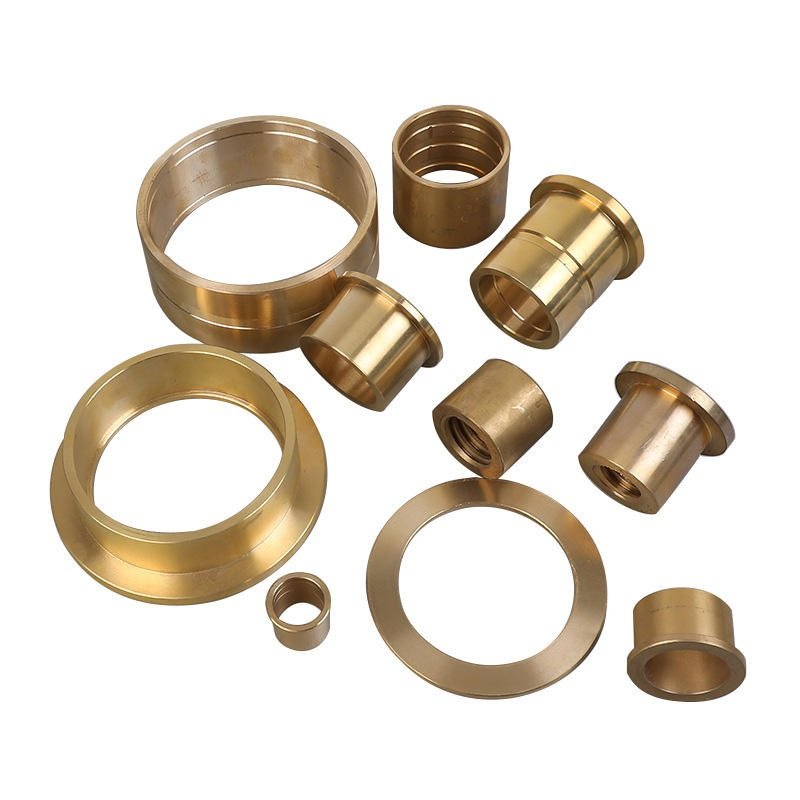
Custom Bronze Bushings Manufacturer & Supplier
A technical guide to the selection, specification, and manufacturing of custom cast and machined bronze bearings for heavy-load applications.
1.0 Material Selection Criteria
1.1 The Role of Lead & Tin
Bronze alloys are distinguished by their copper base and alloying elements. Tin increases strength and hardness, while Lead provides lubricity (anti-seizing) properties essential for start-stop applications.
Standard C93200 (SAE 660) is the “workhorse” bearing bronze, offering the best balance of load capacity, wear resistance, and machinability.
1.2 High Load Applications
For oscillating heavy loads (e.g., construction equipment), Aluminum Bronze (C95400) or Manganese Bronze (C86300) is preferred due to higher tensile strength (>90 ksi) and fatigue resistance, though they require harder shafts.
2.0 Material Specification Matrix
| Alloy (UNS) | Common Name | Tensile Strength | Max Speed (V) | Max Load (P) |
|---|---|---|---|---|
| C93200 | Bearing Bronze (SAE 660) | 35,000 psi | 750 sfm | 4,000 psi |
| C95400 | Aluminum Bronze | 85,000 psi | 1,200 sfm | 4,500 psi |
| C86300 | Manganese Bronze | 110,000 psi | 250 sfm | 8,000 psi |
| C54400 | Phosphor Bronze | 40,000 psi | 1,000 sfm | 3,500 psi |
*Values are approximate. Consult engineering for specific design factors.
3.0 Tribology: The PV Factor
The primary limiting factor in bronze bushing design is the PV Value (Pressure × Velocity). Exceeding the material’s PV limit generates heat faster than it can be dissipated, leading to seizure.
Equation 3.1: PV Calculation
PV = P × V
Where:
- P (Pressure) = Load (lbs) / (ID × Length)
- V (Velocity) = Surface Speed (ft/min)
Design Guidance
For C93200 Bronze with grease lubrication, we generally recommend keeping the operating PV below 50,000. With periodic oil lubrication, values up to 75,000 may be acceptable.
4.0 Lubrication Distribution
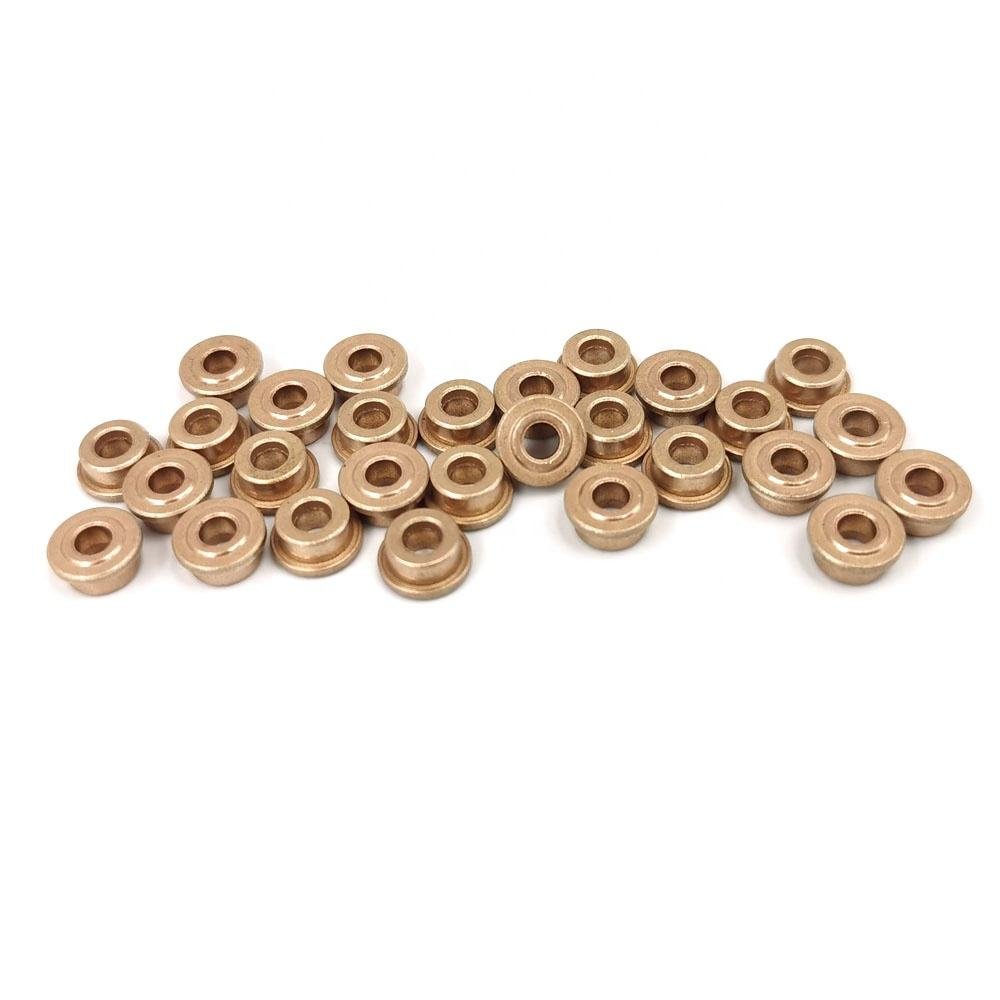
Figure 4.1: Custom machined oil grooves
Proper lubrication film maintenance is critical. We machine custom groove patterns to ensure lubricant reaches the load zone.
- Single Loop (Figure-8) Best for grease lubrication in oscillating applications.
- Straight Axial Simple and effective for full rotation where oil needs to traverse the length.
- Circular / Annular Used for distributing oil from a feed hole to the bearing surface.
5.0 DFM (Design for Manufacturing)
Lead-In Chamfers
Ideally 15-30 degrees to assist in press-fitting without shearing the housing.
Wall Thickness
Keep > 0.060″ (1.5mm) to prevent distortion during machining and installation.
Undercuts
Avoid internal undercuts unless necessary; they require specialized tooling and increase cost.
Press Fit Allowance
Account for ID closure (shrinkage) after press-fitting into the housing (approx 80-100% of interference).
6.0 Quality Assurance Protocol
Material Traceability
Mill Test Reports (MTR) provided for every heat lot to verify chemical composition (Cu, Sn, Pb, Zn).
Dimensional Verification
Air gaging used for critical bore tolerances (+/- 0.0002″) to ensure correct clearance.
Surface Integrity
Visual inspection for casting porosity, inclusions, or machining chatter marks.
7.0 Technical FAQ
Q: Can you machine graphite plugged bronze?
A: Yes, we drill holes and press fit solid graphite plugs for self-lubricating, high-temp applications.
Q: What is the difference between C932 and C954?
A: C932 (Bearing Bronze) has lead for lubricity. C954 (Aluminum Bronze) is much harder and stronger but requires grease.
Q: Do you sell stock sizes?
A: No, we are a custom manufacturing service. We make to print.
Q: Can you hold ISO H7 tolerance?
A: Yes, provided the wall thickness allows for stable machining.
Q: What is the maximum length?
A: Typically 20 inches, depending on diameter and tooling stability.
Q: Do you offer oil impregnation?
A: For sintered bronze, yes. For cast bronze, we rely on grooves and external lubrication.
Q: How do you deburr the oil grooves?
A: We use manual scraping or flexible hones to ensure no raised metal damages the shaft.
Q: Is lead-free bronze available?
A: Yes, C954 Aluminum Bronze is lead-free. Bismuth bronze is also an option.
Q: What is the typical lead time?
A: 3-4 weeks for custom castings and machining.
Q: Do you export?
A: Yes, worldwide shipping with proper rust prevention.
Contact Information
Rongli Industrial Park, Dalang, Longhua District, Shenzhen, China