
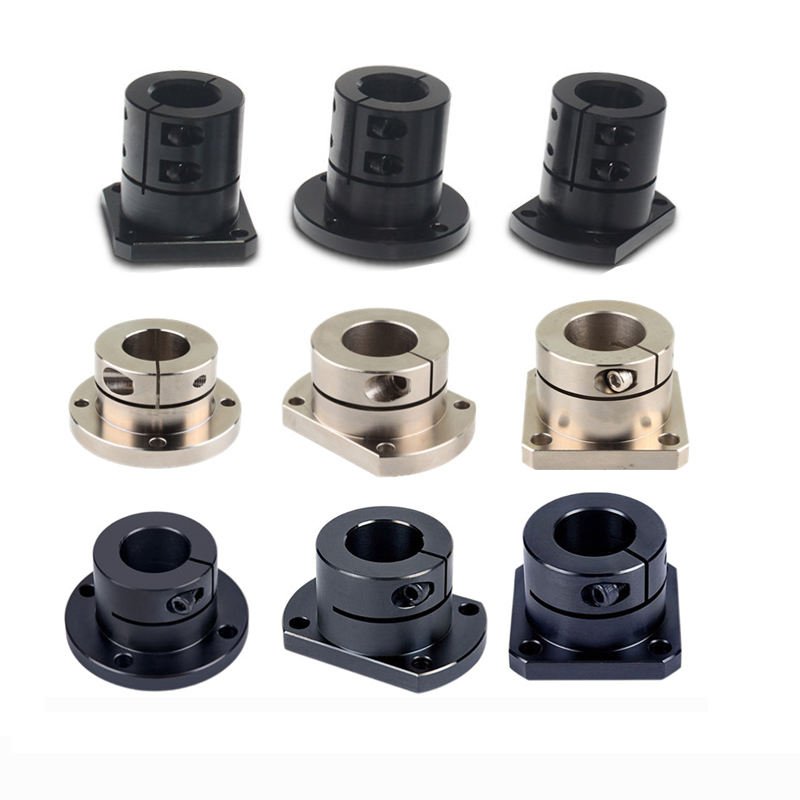
Taper Interface Control for Custom Bushings
Custom taper-lock bushings manufacturer and supplier. Made-to-Drawing Only. Precision fit for critical torque transfer applications.
Critical Functionality
Torque Transfer Efficiency
The taper angle multiplies the clamping force, converting axial screw load into high radial contact pressure, eliminating the need for excessive keyway reliance in lower torque applications.
Self-Centering Capability
Uniform contraction of the split bushing ensures the shaft remains concentric to the hub, reducing vibration and runout at high rotational speeds.
Fretting Corrosion Mitigation
A properly mated taper interface eliminates micro-movements between the shaft and hub, preventing the formation of fretting corrosion which leads to seizure.
Geometry Reference
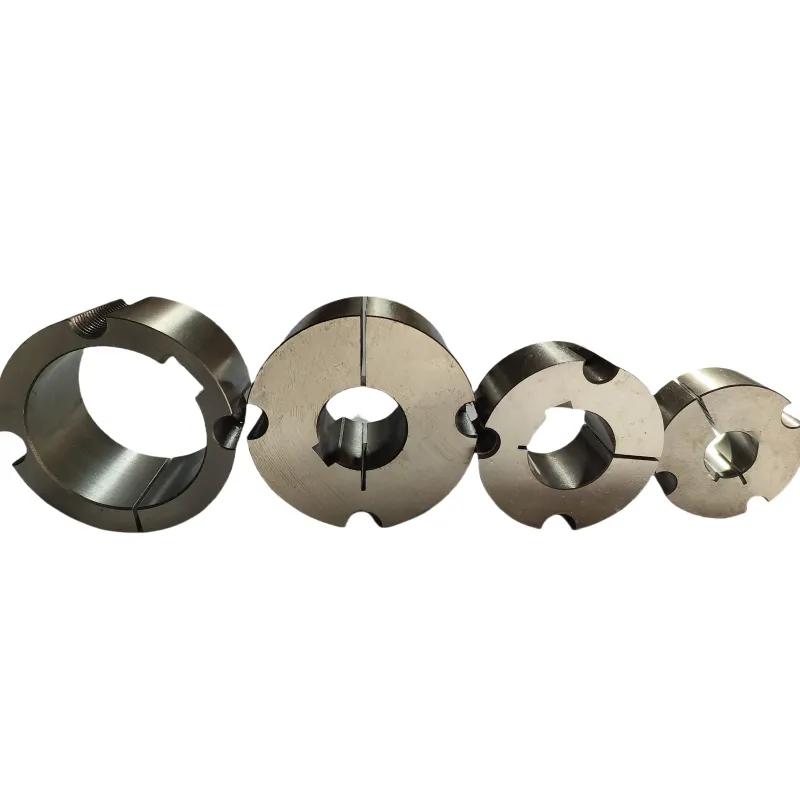
GD&T & Critical-to-Function Checklist
Feature
- Taper Angle Precision
- Bore Diameter Tolerance
- Keyway Symmetry
- Concentricity / Runout
- Surface Finish (Ra)
- Edge Break / Deburring
Engineering Impact
- Mismatched angles cause point contact, reducing torque capacity and leading to wobble.
- Must match shaft tolerance (e.g., h7/k6) to ensure proper clamping without bottoming out.
- Off-center keyways cause imbalance and stress risers in the hub.
- Critical for high-speed applications to prevent vibration.
- Rough surfaces reduce contact area; smooth surfaces improve interference grip.
- Sharp edges cut into the shaft or create stress concentration points.
Technical Specifications Matrix
| Parameter | Custom Capability / Standard |
|---|---|
| Taper Interface | Custom Angles (e.g., 8°), 1:16, 1:10, or matched to existing hub. |
| Bore Tolerance | Per mating shaft & drawing (H7, G7, M6, etc.). |
| Keyway Options | DIN 6885, BS 46, ANSI B17.1, or Custom Profile (Spline/D-Cut). |
| Material Options | Cast Iron (GG25), Steel (C45, 4140), Stainless Steel (304/316), Aluminum (6061). |
| Heat Treatment | Through hardening, induction hardening, or nitriding available upon request. |
| Surface Finish | Ra 1.6µm (Standard) down to Ra 0.4µm (Precision Ground). |
| Coating Options | Black Oxide, Phosphating, Zinc Plating, Electroless Nickel. |
| Inspection Tools | CMM, Taper Ring Gauges, Air Gauges, Hardness Tester. |
| Batch Sizes | Prototype (1-10) to Medium Volume (500-2000). |
| Packaging | VCI Paper, Oil Rust Preventative, Individual Boxing. |
| Marking | Laser Etching, Dot Peen, or Stamping (Part #, Lot #). |
| Traceability | Full Material Certs (3.1) and Dimensional Reports available. |
Inspection & Metrology Plan
CMM Strategy
Coordinate Measuring Machine used to verify complex geometries and hole positions relative to the datum axis.
Taper Gage Method
Blue matching with certified taper ring gauges to ensure contact area exceeds 85%.
Runout Setup
Bench center verification of OD runout relative to the tapered bore datum.
Thread Verification
Go/No-Go plug gauges for set screw holes and jack screw threads.
Surface Roughness
Stylus profilometer checks to confirm Ra/Rz specifications are met.
Calibration
All gauges calibrated annually against NIST/ISO traceable masters.
Failure Mode & Prevention
| Failure Mode | Diagnosis | Engineering Remedy |
|---|---|---|
| Axial Slip | Bushing moves along shaft under load. | Increase clamping force; Check shaft tolerance; Improve bore finish. |
| Fretting | Red rust powder at interface. | Ensure taper angle match; Increase interference; Apply anti-seize. |
| Galling | Surface tearing during installation. | Use dissimilar materials; Improve lubrication; Reduce installation speed. |
| Eccentricity | Vibration; unequal gap closure. | Clean mating surfaces; Check split width; Verify concentricity specs. |
| Keyway Deformation | Rolled edges on keyway. | Insufficient material hardness; Keyway too wide; Over-torque. |
Manufacturing Process Control
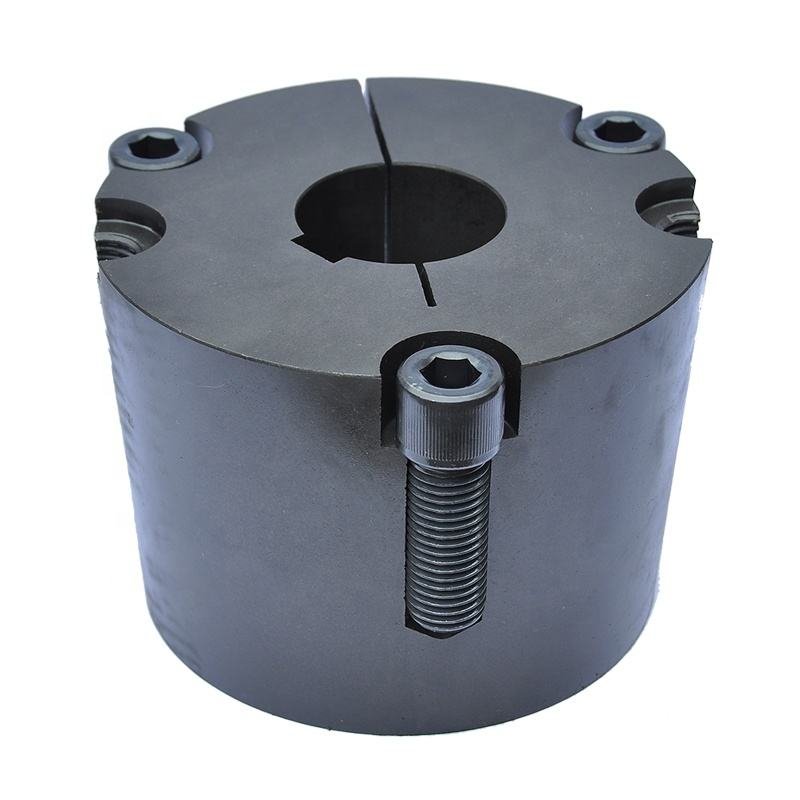
Precision Machining Steps
-
Custom Tooling:
Form tools ground to specific taper angles for consistency.
-
Rigid Clamping:
Specialized fixtures to prevent distortion during thin-wall turning.
-
Burr Control:
Automated deburring cycles to ensure clean split edges and keyways.
DFM Cost Drivers
Tolerance Tightness
Tightening bore tolerance from H7 to H6 significantly increases inspection time and scrap rate.
Keyway Complexity
Standard broached keyways are cost-effective; blind or stepped keyways require EDM.
Surface Finish
Requiring Ra < 0.8µm often necessitates a secondary grinding operation.
Concentricity
High concentricity requirements dictate turning in a single setup or using mandrels.
Batch Volume
Setup costs are amortized over larger runs; typically >50 units sees significant price drops.
Finished Parts Gallery
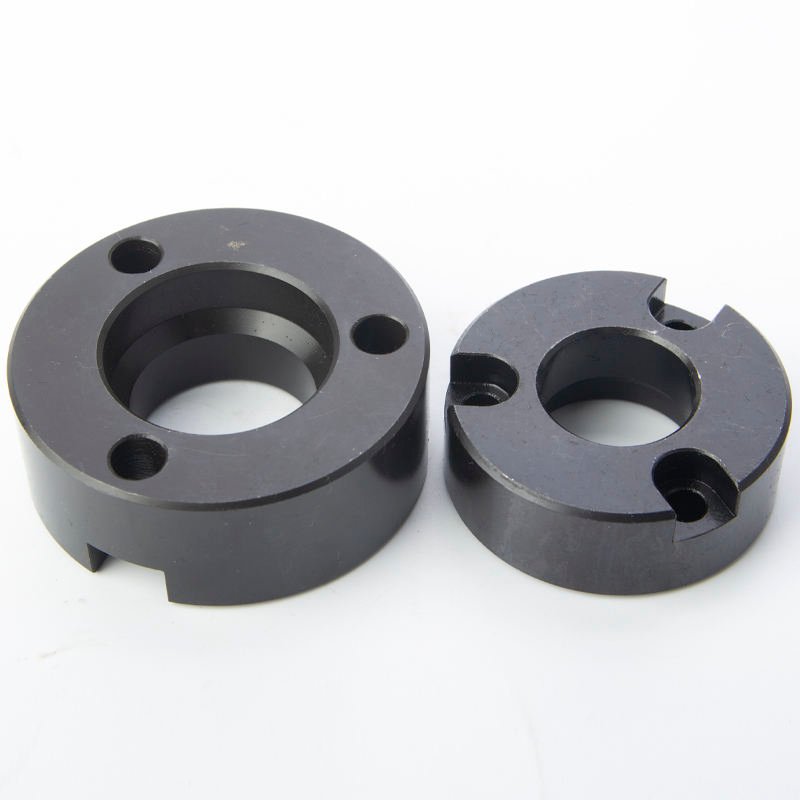
Custom steel taper-lock bushings with black oxide finish, ready for final inspection.
Prepare Your RFQ
- Send 2D PDF with GD&T
- Include 3D STEP/IGES model
- Specify Mating Hub/Shaft Details
Technical FAQ
What is the standard taper angle you use?
We machine to your specific requirement. Common angles include 8 degrees, or standard ratios like 1:8, 1:10, and 1:16. We can reverse engineer from a sample if the angle is unknown.
Can you machine metric and imperial keyways?
Yes, we support DIN, BS, ANSI, and ISO standards for keyways, as well as custom non-standard profiles.
How do you measure runout?
We mount the bushing on a precision tapered mandrel on bench centers and measure TIR (Total Indicator Reading) of the OD and face.
What materials are best for high torque?
For high torque, we recommend heat-treated Alloy Steel (e.g., 4140) or Ductile Iron. Stainless steel is used for corrosive environments but has lower yield strength.
Does coating affect the taper fit?
Yes, thick coatings (like galvanizing) can alter dimensions. We account for coating thickness in pre-plate machining or recommend chemical treatments like Black Oxide which have negligible buildup.
What is tolerance stack-up?
It’s the accumulation of tolerances from the shaft, bushing, and hub. We calculate this to ensure the assembly doesn’t bottom out or fail to clamp.
What is your standard lead time?
Typical lead time for custom bushings is 3-4 weeks. Expedited services are available depending on material availability.
What is the Minimum Order Quantity (MOQ)?
We are a custom manufacturer, so we don’t have a strict MOQ, but unit costs are significantly higher for quantities under 10-20 pieces due to setup.
What files do I need to provide?
A 3D CAD model (STEP/X_T) for CAM programming and a 2D PDF drawing with all critical tolerances and material specs are required.
Do you provide inspection reports?
Yes, we provide full dimensional inspection reports and material test certificates (MTC 3.1) with every shipment upon request.
Start Your Project
Send us your drawings or specs. Our engineering team will review your requirements and provide a DFM report along with your quotation.
info@rapidaccu.comOur Location
Rongli Industrial Park, Dalang
Longhua District, Shenzhen, China