
Assembly & Automation Fixtures & Jigs
Turn assembly into a controlled process, not a human guess. We build tooling that makes your station predictable—shortening takt time and eliminating errors.
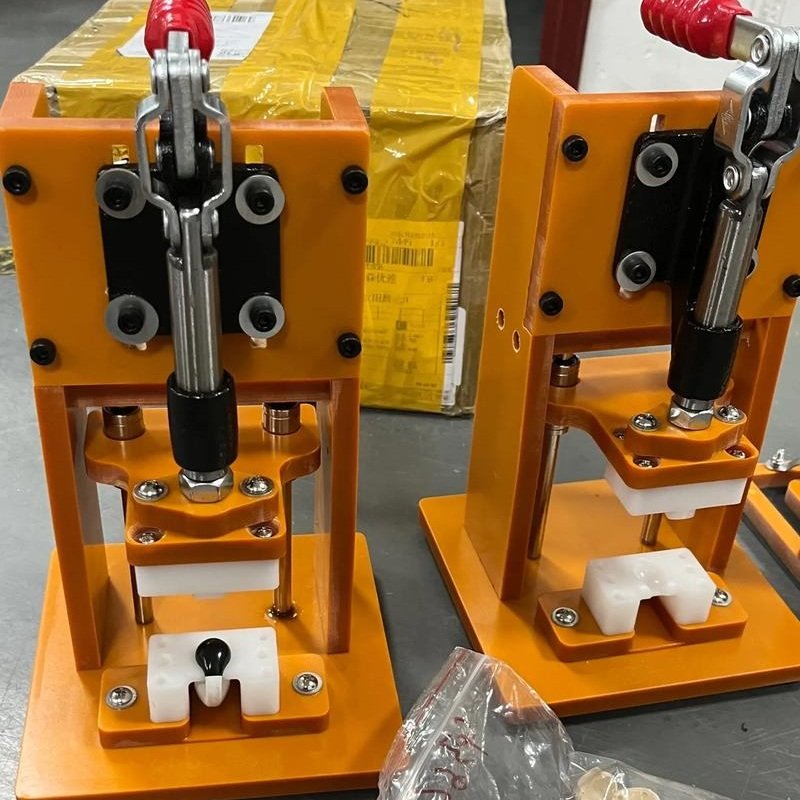
Consistency Over “Skilled Hands”
The fastest lines don’t rely on human intuition—they rely on fixtures, guided motion, and error-proofed steps. We focus on shorter takt time, fewer errors, and smooth automation handoff.
Short Takt Time
Eliminating micro-delays in alignment and fit-up.
Error Proofing
Poka-Yoke geometry prevents wrong orientation.
Robot Ready
Repeatable posture for seamless automated handoff.
Where Lines Lose Money (And How We Fix It)
Hidden Takt Time
Operators fighting fit-up or re-trying insertions cost seconds every cycle.
Fix: Guided locating & self-seating nests.
Intermittent Defects
Parts “almost” aligned or missing seating depth are hard to trace.
Fix: Hard-stops & sensor-ready depth refs.
Wrong-Part Errors
Expensive mistakes that propagate downstream and cause scrap.
Fix: Keyed interfaces & asymmetric locating.
Automation Instability
Robots failing because parts aren’t in a repeatable posture.
Fix: Robot-friendly refs & pickup features.
Assembly & Automation Tooling We Build
Manual Assembly
Designed for natural loading motion and clear “home position” feedback.
- • Multi-part stacking operations
- • Ergonomic clamp layouts
- • Tool access optimization
Poka-Yoke Stations
Keyed nests and orientation-sensitive geometry to prevent errors.
- • “Only fits one way” geometry
- • Part-presence mechanical features
- • Keyed locating for variants
Press-Fit & Insertion
Controlled alignment and depth for bearing or bushing insertion.
- • Hard-stops for depth consistency
- • Force path support design
- • Protection of sensitive faces
Automated Cells
Built for stable robotic screw-driving and dispensing operations.
- • Sensor-ready mounting refs
- • Consistent pickup posture
- • Cable & air routing awareness
EOAT & Grippers
Reliable gripping and repeatable part presentation to next stations.
- • Anti-slip contact geometry
- • Surface-safe handling pads
- • Maintainable wear components
Building Stations Backwards
Instead of asking “how do we clamp it?”, we analyze the final assembled result and work backwards to ensure speed and error prevention.
Complete Deliverables
We deliver more than metal. We deliver a station ready for immediate handover.
- • Assembly fixture/jig hardware
- • Spares plan & wear part kit
- • Maintenance & adjustment notes
- • Revision-controlled drawings/BOM
What We Need to Quote & Start
Still defining your process? Send what you have—we’ll help stabilize it.
Upload Drawings / Request ConceptFixture Development Process
Part & Step Review
Analysis of errors & sequences.
Station Concept
Locating, seating, and Poka-Yoke.
Detail & Build
Precision mfg & wear selection.
Try-out & Handoff
Validation for production ramp.
Why Choose Rapidaccu
Alignment First
We design for “hold accurately and stay stable” to improve yield.
Error Mindset
Stations designed to make common assembly errors impossible.
Measurement Ready
Tooling that helps you measure consistently, not argue endlessly.
ECO-Friendly
Modular architectures that allow fast iteration for ECO changes.
Assembly Tooling FAQ
How do you prevent operator errors in assembly?
Can you design fixtures for robotic pick-and-place?
How do you handle frequent ECO/ECN changes?
What is the typical lead time?
Secure Your Takt Time
Want faster assembly without sacrificing quality? Send us your parts and assembly steps. We’ll reply with an Assembly Station Concept and a quote.
Engineering Support
info@rapidaccu.comService Coverage
Global precision manufacturing & station support.
Request Assembly Concept
Confidential technical review within 24 hours.