
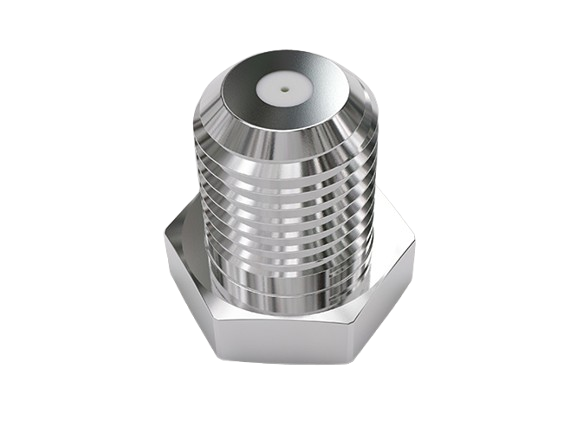
Zirconia Ceramic Nozzles
(Built for Harsh Environments)
When metal nozzles corrode, plastic nozzles deform, and coated parts peel, zirconia ceramic becomes the reliable choice for stability, chemical resistance, and long service life.
Why Do Standard Nozzles Fail?
In many industrial systems, the nozzle is a small component—but it defines how stable the process runs. Typical failure patterns we see from customers switching to zirconia ceramic:
Chemical Attack & Pitting
Stainless steel can resist many fluids, but certain acids/alkalis gradually cause surface degradation and leakage risk.
Thermal Deformation
In temperature cycles, polymers can creep; even slight distortion affects alignment and sealing.
Abrasive Wear
Once the internal geometry wears, the nozzle may still “spray”, but performance becomes unpredictable.
What Makes Zirconia Ceramic Different?
Zirconia (ZrO₂) is widely used in high-performance engineering components because it offers a rare combination of properties.
Ideal for long-running systems where maintenance downtime is costly.
Designed for Consistency, Not Just Durability
The performance difference between ceramic nozzles is not only material—it’s precision control of geometry. Rapidaccu approaches each ceramic nozzle as a functional precision component.
OEM Collaboration
Full DFM review included
Controlled Machining
Strategy for brittle materials
Critical Inspection
Features & interface fit
Scalable Capacity
Prototype → Production
Where Zirconia Ceramic Nozzles Are Used
Chemical Processing
Resists corrosion for aggressive media and harsh cleaning cycles.
High-Temp Zones
Suitable for environments where thermal stability matters for alignment.
Continuous-Run Lines
Ideal when frequent nozzle replacement creates hidden labor losses.
Precision Cleaning
Stable geometry helps maintain repeatable coverage characteristics.
Wear-Prone Systems (Abrasives)
Ceramic helps reduce geometry changes over time compared to soft metals.
Custom Options We Support
We can customize zirconia ceramic nozzles based on your specification priorities:
Performance Targets
Stability requirements, wear life expectations, chemical compatibility.
Mechanical Interfaces
Custom dimensions, sealing features, custom thread (project-based).
Geometry & Features
Outlet feature customization, internal channel optimization, hybrid designs.
Material Comparison
| Criteria | Zirconia | Stainless | Plastic |
|---|---|---|---|
| Corrosion | Excellent | Good | Good |
| Wear | Very High | Medium | Low |
| High Temp | High | High | Limited |
| Stability | Excellent | Good | Creep |
What We Need to Quote
Files & Samples
- Drawing (STEP / PDF)
- Sample photo (w/ dimensions)
- Physical sample (Reverse Eng)
Target Info
- Media type (Chemical/Abrasive)
- Working temp & pressure
- Expected quantity
A Low-Risk OEM Workflow
Requirements
Confirm constraints
Prototype
Functional verification
Pilot Batch
Reliability confirmation
Scale
Locked parameters
Why Rapidaccu?
Ceramic parts succeed or fail by manufacturing discipline. We offer engineering review before cutting, support for aggressive timelines, and quality control built into each step.
Frequently Asked Questions
When should I choose zirconia ceramic nozzles over stainless steel?
Are zirconia ceramic nozzles suitable for high temperature?
Can Rapidaccu manufacture custom ceramic nozzles from a sample?
Is ceramic brittle? Will it crack easily?
What files should I send for the fastest quotation?
Get a Custom Zirconia Ceramic Nozzle Quote
If you’re dealing with corrosion, wear, or unstable process output, zirconia ceramic may be your best long-term solution.
- OEM support & DFM included
- Prototype-first to reduce risk
- Stable production supply available