
Custom Aluminum
Rollers
Precision-machined 6061 & 6063 aluminum rollers with G2.5 dynamic balancing, Ra ≤0.1μm surface finish, hard anodizing, and PTFE coating — built for high-speed printing, packaging, textile, and battery film winding equipment.
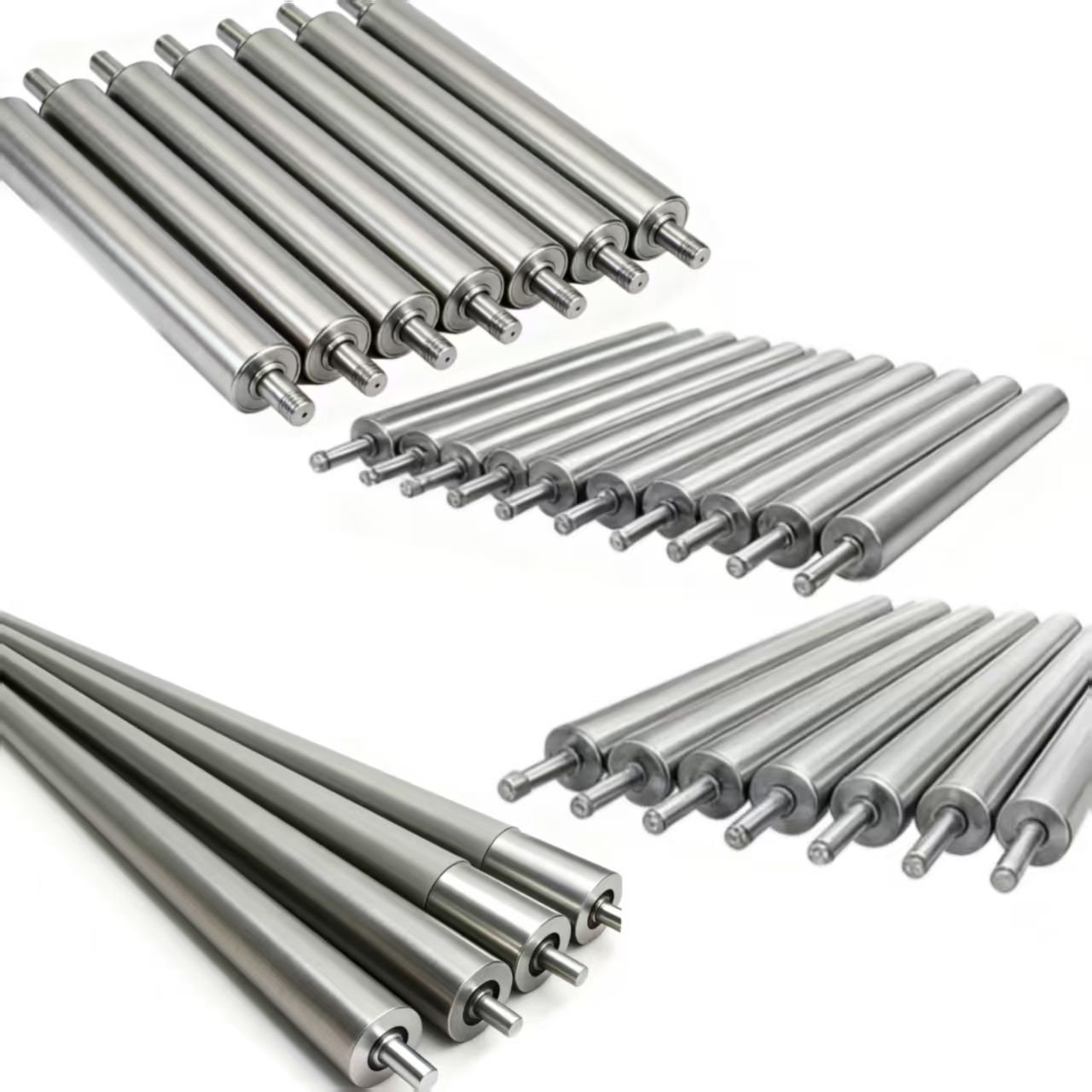
Why Choose Aluminum Rollers Over Heavier Alternatives
In converting and web-handling systems, the material choice directly affects machine performance. Lower roller weight reduces inertia, allowing faster acceleration and deceleration — critical for servo-driven systems and precise tension control.
Aluminum also offers excellent machinability, enabling custom geometry, internal cavities, and shaft interfaces that would be more difficult or less economical to produce in harder materials. With the right surface treatment, aluminum rollers match the functional demands of much heavier alternatives.
Discuss Your Design →| Factor | Aluminum | Steel |
|---|---|---|
| Weight | Much lower density | Significantly heavier |
| Rotational Inertia | Low with lightened design | Higher |
| Machinability | Excellent | Moderate |
| Corrosion Resistance | Good, enhanced by anodizing | Depends on coating/alloy |
| Surface Options | Hard anodize, PTFE, polish | Plating, grinding, coating |
| Energy Efficiency | Lower drive energy required | Higher energy demand |
Manufacturing Capabilities
Custom production of aluminum rollers tailored to your drawing, operating speed, and assembly requirements
Ultra-Thin-Wall CNC Turning
High-speed CNC machining of thin-wall aluminum roller bodies. Reduces rotational mass and inertia while preserving the geometric accuracy required for bearings and journal interfaces.
Internal Weight-Reduction Milling
Internal milled structures optimise stiffness-to-weight ratio. Allows substantial inertia reduction without compromising functional geometry needed for mounting, bearings, or drive connections.
G2.5 Dynamic Balancing Standard
Standard G2.5 dynamic balance on every roller. Reduces vibration, protects bearings and machine structure, enables smoother high-speed web transport, and lowers noise levels during operation.
Ra ≤0.1μm Surface Finish
Mirror-level surface quality achievable on the roller OD. Suitable for applications involving films, coated substrates, and sensitive materials where scratch prevention and consistent contact are critical.
600mm Dia. × 6000mm Length
Wide size range supporting both compact automation systems and large-format web-processing equipment. Custom dimensions within this range available based on your drawing and application.
Custom Shaft-End Geometry
Stepped diameters, integrated shaft ends, hollow bodies, journals, and custom mounting interfaces — all machined to your drawing for direct machine integration without secondary modification.
| Specification | Capability | Benefit to Equipment Builders |
|---|---|---|
| Available Alloys | 6061, 6063 aluminum | Good balance of strength, machinability, and surface treatment compatibility |
| Maximum Diameter | 600 mm | Supports larger transport, guide, and drive roller applications |
| Maximum Length | 6000 mm | Suitable for wide web handling and continuous processing lines |
| Thin-Wall Turning | High-speed CNC machining | Reduces roller mass and rotational inertia |
| Internal Light-Weighting | Milled internal structures | Optimises stiffness-to-weight ratio |
| Standard Balance Grade | G2.5 dynamic balancing | Smooth high-speed performance and reduced vibration |
Surface Treatments
Keep the weight advantage of aluminum while significantly improving hardness, abrasion resistance, and application-specific functionality
| Treatment | Main Benefit | Typical Applications | Key Consideration |
|---|---|---|---|
| Hard Anodizing | Increased hardness & wear resistance | Guide, transport, contact rollers | Good for long service life under friction |
| PTFE Coating | Low friction and anti-stick | Film handling, adhesive contact, packaging | Useful where release performance matters |
| Mirror Polish | Very smooth surface Ra ≤0.1μm | Optical film, thin film, sensitive substrates | Reduces surface marking |
| Machined Finish | Cost-effective baseline | Low-wear or temporary equipment | Best where surface load is limited |
Key Industrial Applications
Speed, precision, and lightweight rotating components directly affect output quality and machine efficiency. Application fit drives custom roller design at Rapidaccu.
Design Considerations & Selection Checklist
Choosing the right aluminum roller requires more than matching diameter and length. Evaluate the roller as part of your full machine system.
Size — Diameter & Face Length
Determines stiffness, speed behavior, and geometric fit in the machine frame. Longer and larger-diameter rollers require more attention to deflection under load.
Speed — RPM & Line Speed
Influences balance requirement and inertia target. Higher speeds and frequent stop-start cycles favour lower inertia designs with thin walls or internal light-weighting structures.
Load — Contact Pressure & Tension
Affects wall thickness and structural design decisions. Heavy contact pressure or high web tension requires a more robust roller construction to prevent deflection or deformation.
Surface — Roughness, Hardness, Friction
Determines finish and coating selection. Sensitive films need fine roughness and low friction; abrasive conditions need hard anodizing; adhesive contact may need PTFE.
Environment — Humidity, Chemicals, Temperature
Impacts alloy and surface treatment choice. Anodizing improves corrosion resistance in humid or chemically exposed environments. Temperature extremes affect coating selection.
Mounting — Journal, Shaft Form, Bearings
Ensures assembly compatibility and concentric running. Journal size, shaft form, keyways, and bearing interface details all need to match your machine design precisely.
Why Rapidaccu for Custom Aluminum Rollers
The challenge is not finding a shop that can machine a cylinder. The real challenge is finding a supplier that understands why roller weight, balance, finish, and coating must work together.
Frequently Asked Questions
Common questions about custom aluminum rollers from equipment manufacturers and OEM buyers
What are aluminum rollers used for?
Why choose aluminum rollers instead of steel rollers?
Can aluminum rollers handle high-speed operation?
How smooth can the roller surface be?
What sizes can you manufacture?
What coatings are available?
Can you make lightweight internal structures?
Do you support custom OEM production?
Request a Quote for Custom Aluminum Rollers
Share your drawing, dimensions, and application details. We will review for manufacturability and recommend the most practical solution for weight reduction, surface performance, and production efficiency.
Contact Rapidaccu
Dalang, Longhua District,
Shenzhen, China
- ✓Roller diameter and length
- ✓Material preference: 6061 or 6063
- ✓Operating RPM or line speed
- ✓Surface roughness and treatment target
- ✓Shaft/journal and mounting details
- ✓Quantity and delivery schedule