
Custom Tapered Rollers for Conveyor Curves
Rapidaccu manufactures custom tapered conveyor rollers with precise CNC cone geometry, strong welded construction, and full customization for non-standard layouts — built for airports, parcel hubs, and packaging lines.
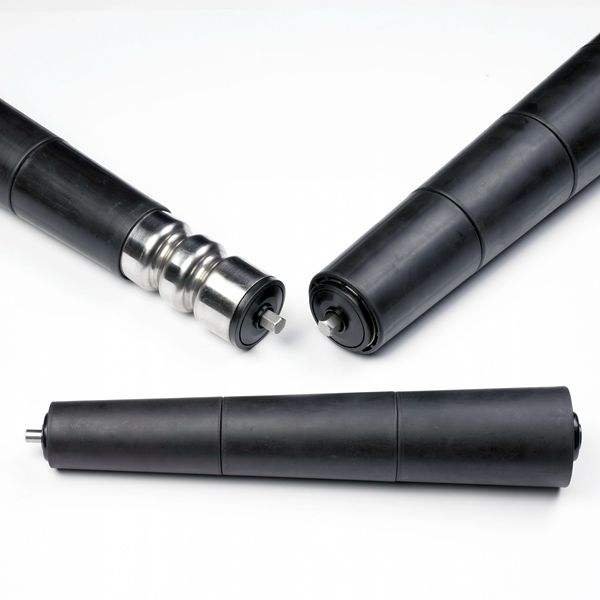
Solving the Curve Speed-Mismatch Problem
In curved conveyor sections, straight rollers create unequal line speed from the inner to outer radius. That mismatch causes carton skewing, unstable tracking, increased wear, and higher side loads.
Custom tapered rollers solve this with a controlled conical surface so effective conveying speed stays aligned across the product width through the curve. Our standard design uses a 2 mm steel plate tapered tube with steel bearing housings welded to both ends and protective dustproof and waterproof end caps.
Get Drawing-Based QuoteAccurate Cone Geometry
Multi-axis CNC machining delivers tight taper angle and cone profile control for consistent speed matching under load.
Welded Steel Construction
Precision high-strength welding joins the tapered tube and steel bearing housings into a durable rotating assembly.
Dustproof & Waterproof
End caps protect bearings against contamination in logistics, food, and industrial environments.
Non-Standard Geometry
Custom taper angles, lengths, shaft ends, and diameters produced to your drawing without catalog constraints.
Technical Specifications
Performance depends on more than major and minor diameters. Here is the complete standard configuration for Rapidaccu custom tapered rollers.
| Specification | Standard / Range | Benefit for Conveyor Application |
|---|---|---|
| Taper angle Core | 3.6° standard, custom per drawing | Supports accurate line-speed matching in conveyor curves |
| Tube material | 2 mm steel plate formed tapered tube | Good structural strength and cost-effective durability |
| Bearing housing | Steel bearing seats on both sides | Stable support for rotating assembly under load |
| Assembly method | Precision high-strength welding | Strong connection between tube and bearing housing |
| End protection | Dustproof and waterproof end caps | Helps reduce contamination-related bearing issues |
| Operating temperature | −10°C to +80°C | Suitable for typical indoor logistics and packaging environments |
| Max load capacity Key | Up to 200 kg | Supports demanding baggage, parcel, and packaging loads |
| Manufacturing method | Multi-axis CNC controlled cone machining | Precise taper surface and repeatable geometry |
Custom configurations available: If your project requires a custom shaft design, specific mounting details, or modified roller lengths, our team can review the required interface conditions and recommend a manufacturable configuration — especially useful for integrators replacing obsolete rollers or designing compact turn sections.
Why Choose Rapidaccu for Custom Tapered Rollers
Buying custom tapered rollers is rarely just a purchasing task. It is usually tied to a system-level problem — a curve that does not track cleanly, a turn that damages cartons, a retrofit needing non-standard dimensions, or a project where cost and performance both matter.
Our manufacturing capability is built around advanced multi-axis CNC machining centers and flexible programming, making it easier to produce special geometries that conventional processes struggle to deliver efficiently.
Discuss Your ProjectMulti-Axis CNC Machining
Advanced machining centers and flexible programming allow non-standard geometries that are difficult or inconsistent to produce by conventional methods.
Precision High-Strength Welding
Tapered tube and steel bearing seats joined with a precision welding process — creating durable assemblies for repeated sorting and conveying duty.
End Contamination Protection
Dustproof and waterproof end caps defend bearings from debris, moisture, and washdown exposure that commonly shortens component life.
Drawing-Based Custom Supply
OEM, integrator, and retrofit projects all supported — from concept review and drawing evaluation through prototype and volume production.
Applications for Custom Tapered Rollers
Custom tapered rollers are essential wherever products must move smoothly through a curved conveyor path without losing orientation or creating excessive side pressure.
Airport Baggage Handling
Roller curves need consistent speed matching to keep luggage stable through sorting and transfer zones. Durable construction and accurate taper geometry are essential for high-cycle reliability in airport environments.
Postal & Express Parcel Sorting
High-volume curves where package sizes vary and downtime is costly. Tapered rollers help maintain throughput with geometry accuracy and contamination protection that holds up under demanding sort rates.
Food & Beverage Packaging
Controlled turning in compact machine footprints. Custom dimensions, environmental sealing, and smooth product flow make tapered rollers the right fit for curved sections in packaging and cartoning systems.
Material, Construction, and Durability
A tapered roller is exposed to rotating loads, localized stress at bearing interfaces, contamination risk at the ends, and repeated dynamic contact across the conveying surface. Construction quality determines service life.
2 mm Steel Plate Tube Body
The tapered tube is formed from 2 mm steel plate, providing the combination of strength, dimensional stability, weld compatibility, and cost efficiency needed for airport logistics and parcel handling equipment.
Precision Welded Bearing Seats
Steel bearing housings are integrated with the tube through precision high-strength welding, creating a rigid assembly that supports reliable rotation and long-term service under load cycles.
Dustproof & Waterproof End Caps
End sealing protects bearings in environments from −10°C to +80°C where dust, moisture, and cleaning exposure routinely shorten component life if sealing is inadequate.
| Construction Feature | Design Detail | Operational Advantage |
|---|---|---|
| Tapered tube body | 2 mm steel plate | Strong, durable shell for repeated conveying duty |
| Bearing support ends | Steel bearing housings | Better structural stability and load support |
| Tube-to-end connection | Precision high-strength welding | Reliable assembly integrity under dynamic loads |
| End protection | Dustproof and waterproof caps | Helps reduce bearing contamination and maintenance risk |
| Cone geometry control | Multi-axis CNC machining | Accurate taper angle for consistent curve performance |
Customization Options for Your Conveyor System
Many conveyor systems fail because standard components are forced into applications they were not designed for. Our standard taper is 3.6°, but we can manufacture to your specified cone angle based on conveyor radius, product footprint, and speed-matching requirements.
| Customization Area | Typical Requirement | Why It Matters |
|---|---|---|
| Taper angle | Standard 3.6° or custom | Affects speed matching through the curve |
| Roller dimensions | Major/minor diameters, face length | Must fit frame width and product path |
| End details | Shaft or interface modifications | Ensures compatibility with system mounting |
| Load requirement | Up to 200 kg application review | Confirms structural suitability for duty |
| Environment | Temperature and contamination exposure | Supports correct sealing and operating reliability |
If you already have a drawing, we can quote directly. If not, we can review your application data and help define the right tapered roller specification for your curve.
Manufacturing Process for Precision Cone Geometry
The key to effective custom tapered rollers is not just a cone shape — it is producing that geometry accurately and repeatably so the roller performs correctly once installed in a conveyor curve.
Drawing Review & Programming
Customer drawing or application data is reviewed and CNC program is created for the specific taper angle, diameters, and interface geometry.
Step 1Multi-Axis CNC Cone Machining
Advanced CNC machining centers produce the conical surface with controlled accuracy — especially critical for non-standard taper angles and profiles.
Step 2Precision High-Strength Welding
Steel bearing housings are assembled and joined to the tapered tube body using a precision welding process that ensures structural integration for dynamic duty.
Step 3End Cap Assembly & QC
Dustproof and waterproof end caps are added. Final dimensional verification confirms that geometry matches the specified taper profile before delivery.
Step 4Manufacturing precision benefits for B2B buyers
Better dimensional control for custom cone profiles — repeatable across batch production — strong welded construction suited to industrial use — practical cost control for custom projects.
Selecting the Right Custom Tapered Rollers
Choosing custom tapered rollers should start with system behavior, not just dimensions. The right roller needs to suit curve geometry, product type, operating temperature, and load condition.
Airport Baggage Handling
Focus on stable movement and durability under repeated handling cycles. Accurate taper geometry and durable welded construction are the priority for reliable operation in high-cycle baggage sorting environments.
Geometry accuracy + durable constructionPostal and Express Sorting
Prioritize geometry accuracy and contamination protection because high throughput quickly exposes weak components. Load capacity and repeatable dimensional accuracy support consistent sort performance.
Load capacity + sealing + dimensional accuracyFood & Beverage Packaging
Consider smooth product flow, environmental exposure, and fit within compact machine footprints. Custom dimensions, contamination protection, and temperature suitability are key specification points.
Custom dimensions + contamination protectionRetrofit Conveyor Upgrade
Fit existing frames and restore curve performance. Drawing-based customization and interface compatibility allow drop-in replacement of worn or obsolete curve rollers without modifying the conveyor structure.
Drawing-based fit + interface compatibilityWhat to Confirm When Specifying
Taper angle for the curve
Standard 3.6° or custom per conveyor radius
Major and minor diameters
Roller face length and overall length
End / shaft mounting details
Compatibility with existing frame mounting
Load per roller
Confirm structural suitability, max 200 kg
Operating temperature range
Design range: −10°C to +80°C
Moisture or dust exposure
Determines sealing requirement for end caps
Ordering Process and Engineering Support
Ordering custom tapered rollers should not require guesswork. Many buyers have partial information — perhaps an old sample, a maintenance drawing, a conveyor layout, or only the operating problem they need to solve. Rapidaccu supports both fully specified projects and early-stage technical inquiries.
Send drawing, dimensions, or application details
Taper angle, diameters, length, shaft details, load, environment, and quantity. Photos or sketches also accepted.
Technical review and configuration recommendation
Our team reviews manufacturability and confirms the recommended tapered roller configuration for your conveyor application.
Quote and technical alignment before production
Quotation provided with technical confirmation — suitable for OEM sourcing teams, engineering departments, and MRO buyers.
| Information to Provide | Example Details | Why It Helps |
|---|---|---|
| Geometry | Taper angle, diameters, roller length | Defines cone profile and fit |
| Interface | Shaft style, mounting details, bearing seat needs | Ensures installation compatibility |
| Load and duty | Max product weight, cycle frequency | Confirms structural suitability |
| Environment | Temperature, dust, moisture exposure | Supports correct protection features |
| Quantity | Prototype, project batch, repeat demand | Helps optimize production planning |
If you do not have a full print, we can still review photos, sketches, or system descriptions. The goal is to make sourcing custom tapered conveyor rollers more practical for specialized curve applications.
Frequently Asked Questions
Technical and commercial answers for engineers and buyers sourcing custom tapered conveyor rollers from Rapidaccu.
What are custom tapered rollers used for?
What is your standard taper angle?
What industries are tapered conveyor rollers suitable for?
What load can the tapered rollers handle?
What operating environment can these rollers handle?
Can you manufacture non-standard sizes and geometries?
What information do you need for a quote?
How does tapered roller geometry improve curve conveying performance?
Request a Quote for Custom Tapered Rollers
Whether you need a standard 3.6° tapered roller, a drawing-based non-standard geometry, or a cost-effective solution for a complex turning section — send us your requirements and we will review and recommend a suitable manufacturing approach.
Contact Rapidaccu
Reach out with your drawing, roller dimensions, or application requirements for a fast technical review and quotation.
Longhua District, Shenzhen, China
- Taper angle, diameters, and roller length
- Roller drawing or sample photos
- Shaft and end mounting details
- Load, speed, and operating environment
- Required quantity and delivery schedule
Send Your Enquiry
Complete the form with your project details and we will respond with a technical review and quotation.