
Aluminum 6061 vs 7075 vs 5052 vs 2024 – A 15-Year Engineer’s Selection Guide
By Jack
15-Year Manufacturing Engineer at Rapidaccu
“I’ve seen thousands of drawings come through Rapidaccu. The most expensive mistake isn’t the machining—it’s picking the wrong aluminum grade. Choosing 7075 when 6061 would do can triple your material cost, while choosing 6061 for a marine part can lead to total failure in months. This guide is my ‘cheat sheet’ for getting it right the first time.”
Get an Engineering Review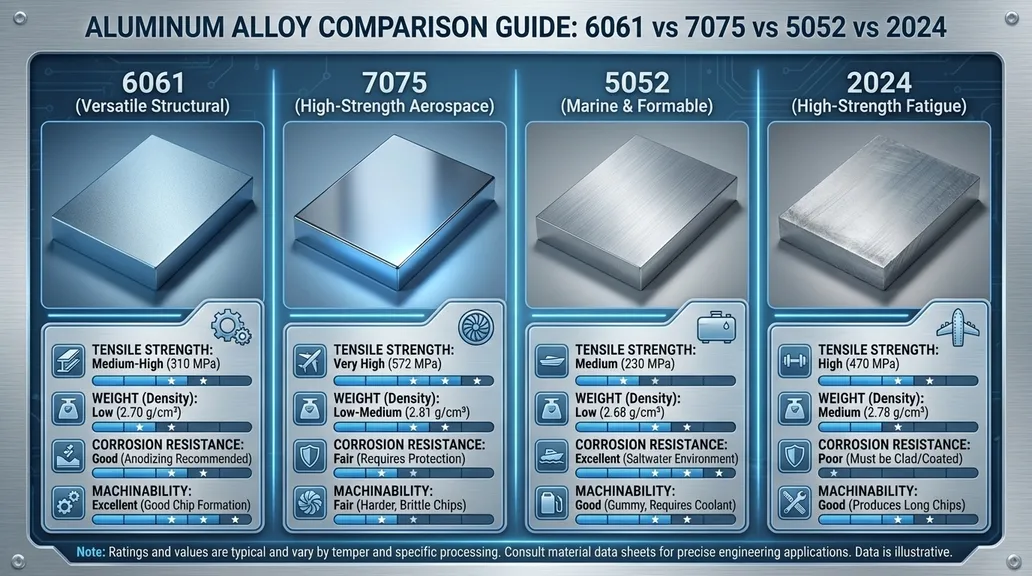
Engineering Decision Flowchart
Navigating aluminum grades doesn’t have to be complex. This visual guide breaks down the selection process based on your project’s primary requirements—whether you’re prioritizing structural integrity, extreme corrosion resistance, or ease of manufacturing.
Step 1
Primary Project Need?
Structural Strength
Corrosion / Marine
Sheet Metal Bending
Step 2
Key Constraint?
Budget & Availability
Extreme Mechanical Load
Verdict
Recommended Grade
The Industry Standard
High Performance
Master Comparison Table: Properties at a Glance
| Grade | Tensile Strength (MPa) | Yield Strength (MPa) | Corrosion Resistance | Weldability | Machinability | Formability | Cost Level |
|---|---|---|---|---|---|---|---|
| 6061-T6 | 310 | 275 | Excellent (Stable) | Excellent (HAZ Loss) | Good | Good | $$ |
| 7075-T6 / T7351 | 570 | 505 | Fair (SCC Risk) | Poor | Fair | Poor | $$$$ |
| 5052-H32 | 230 | 190 | Superior | Excellent | Mirror Finish* | Superior | $ |
| 2024-T3 | 480 | 345 | Poor | Poor | Superior | Fair | $$$$ |
| 6063-T6 | 185 | 145 | Excellent | Excellent | Fair | Excellent | $ |
6061 vs 7075: Strength vs. Cost
“If 6061 is the workhorse, 7075 is the thoroughbred. I tell my clients: don’t buy the thoroughbred if you’re just plowing a field.”
6061-T6 Advantage
The best all-rounder. Excellent corrosion resistance and weldability. If your part doesn’t face extreme mechanical stress, 6061 is the default choice.
7075-T6 Advantage
Unmatched strength-to-weight ratio. Used in aerospace where every gram counts. However, it’s prone to stress-corrosion cracking and is double the price of 6061.
Typical Applications
6061-T6
Bicycle Frames
CNC Brackets
Heat Sinks
7075-T6
Wing Spars
Gears & Shafts
Rock Climbing Gear
The HAZ Welding Trap
“Here’s what they don’t teach you in most catalogs: welding 6061-T6 causes a massive drop in strength in the Heat Affected Zone (HAZ). Without post-weld heat treatment, your joint strength plummets by 30-50%, effectively reverting to the ‘O’ (annealed) state.”
SCC & The T7351 Advantage
7075-T6 is the strongest, but it’s vulnerable to Stress Corrosion Cracking (SCC). For critical aerospace components, we often specify the T7351 temper. It sacrifices about 10-15% of peak strength but offers vastly superior resistance to environmental cracking.
The Specialists
Superior resistance to marine environments. High fatigue strength.
High fatigue resistance. Essential for aircraft skin and tension members.
5052 vs 2024: Marine vs. Aerospace
“While 6061 and 7075 dominate the CNC market, 5052 and 2024 are the masters of their domains. One thrives in salt spray, the other in the sky.”
- 5052 is non-heat treatable but work-hardens well.
- 2024 is high-copper; it machines like a dream but corrodes easily.
Fatigue Strength: Why 2024 Rules the Sky
“While 7075 is stronger in static tension, 2024 has higher Fracture Toughness. This is why 2024 is the benchmark for aircraft skins—it can handle millions of vibration cycles without catastrophic crack propagation.”
Sheet Metal vs. CNC: Why 5052 is King
The CNC Choice: 6061-T6
In CNC machining, we want rigidity. 6061-T6 provides that. However, try to bend a 6061-T6 sheet with a tight radius, and it will snap like a cracker. The T6 temper makes it too brittle for aggressive forming.
The Sheet Metal King: 5052
5052 is the “ductile” choice. It flows during the bending process. If your project involves folding, deep drawing, or complex sheet metal fabrication, 5052 is the standard. It maintains strength without the cracking risks.
Learn more about our Aluminum Machining Services
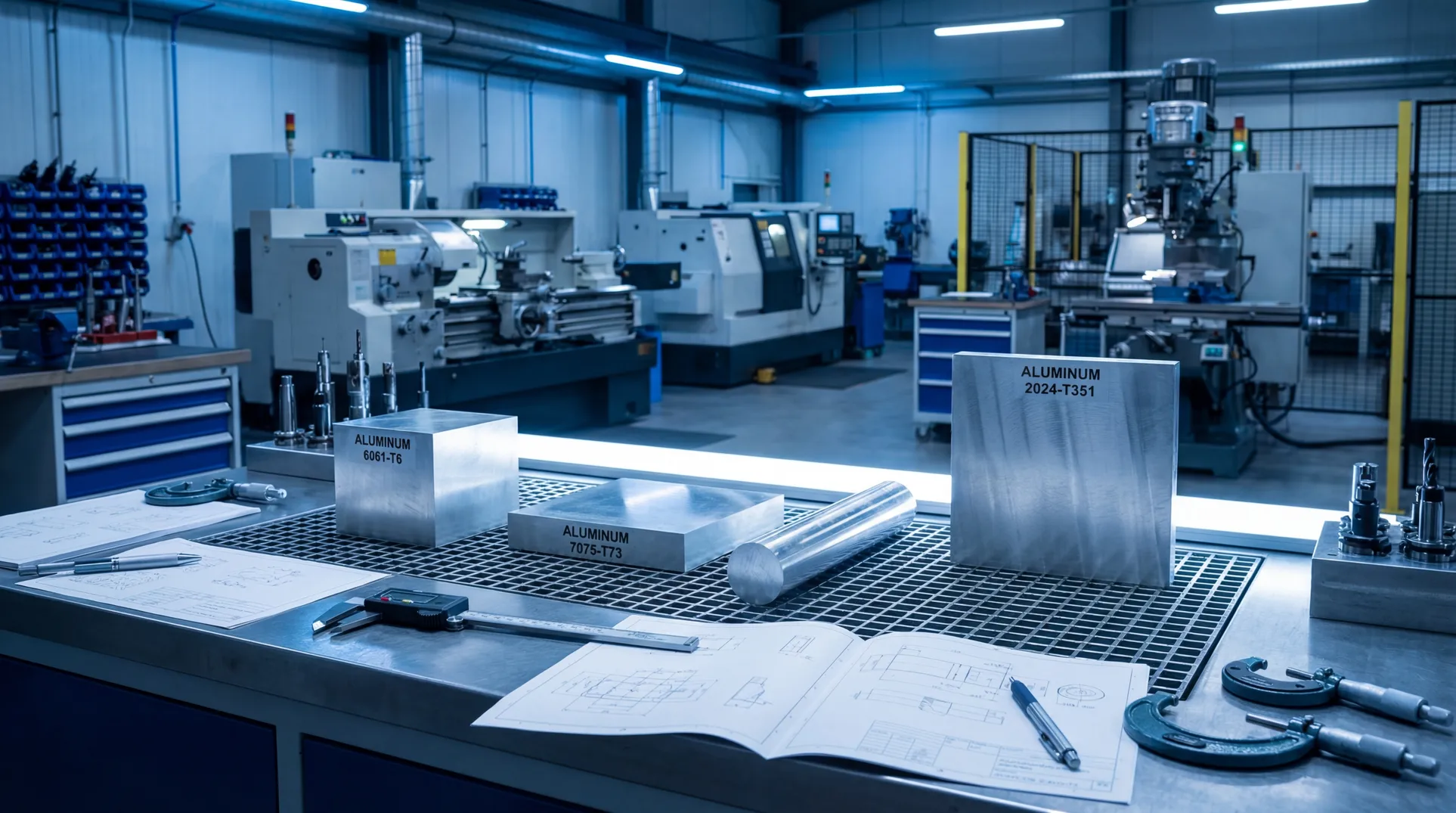
Machining Considerations: Jason’s Shop Floor Insights
The 5052 Mirror Trick
Don’t let the “gummy” reputation scare you. For a mirror finish on 5052, use Single Flute Aluminum-Specific End Mills combined with high-pressure mist cooling. This prevents chip re-welding and produces a jewelry-grade surface.
High-Speed Parameters
Aluminum loves high SFM. For 6061, we push 10,000+ RPM. The key is maintaining a heavy chip load to carry the heat away from the part—slow feeds are what cause melting and tool breakage.
Stress & Warping
7075-T6 has high residual stress. If you’re machining thin-walled aerospace parts, you must use stress-relieved (T651) plate or perform symmetric material removal to prevent the “potato chip” effect.
Visual Evidence: HAZ Failure
Result: 45% reduction in yield strength at the weld toe.
What Engineers Often Get Wrong: 8 Common Pitfalls
Assuming 7075 is always “better.” It’s overkill for 80% of parts and doubles your budget.
Ignoring weldability. Trying to weld 7075 or 2024 leads to catastrophic cracking.
Assuming all Al is “easy to machine.” 5052 is gummy and can ruin tool life if parameters are wrong.
Overlooking Anodizing results. 2xxx series (2024) contains copper, leading to dark, uneven finishes.
Using 6061-T6 for tight bends. It cracks. Use 5052 or 6061-O (annealed) for sheet metal.
Ignoring grain direction. For high-stress structural parts, the orientation of the grain matters.
Thinking strength = fatigue life. 5052 has better fatigue resistance than some high-strength alloys.
Mixing grades in salt-water. Galvanic corrosion can occur even between different aluminum alloys.
Anodizing Depth: The Copper Problem
“Ever wonder why 2024 anodizes so poorly? It’s chemistry. During the acid bath, the Copper (Cu) elements in 2024 precipitate out, disrupting the growth of the aluminum oxide film. This leads to a ‘smutty’, non-continuous coating.”
Aesthetics vs. Alloy Ranking
- 1. 5xxx Series Best for Decor
- 2. 6xxx Series Standard / Consistent
- 3. 7xxx Series Industrial / Functional
- 4. 2xxx Series Poor / Hard Coat Only
Color Anodize
Ideal for 6061. The 1% Magnesium/Silicon content allows for a clean, transparent oxide layer that holds dye perfectly.
Hard-coat (Type III)
Essential for 7075 gears. It’s thick and dark, masking the alloy’s natural susceptibility to surface wear.
The Lead Time Advantage
“In the 2026 manufacturing landscape, material availability is as important as material strength. 6061-T6 is the global standard. We stock it in massive quantities at Rapidaccu, giving it a 40-60% shorter lead time compared to specialty aerospace grades like 7075-T7351.”
Standard Lead Time
3-5 Days (6061)
Specialty Lead Time
10-15 Days (7075)
Our Manufacturing Capabilities
CNC Machining
Sheet Metal
Stamping
Injection Molding
3D Printing
From prototyping to high-volume production, we handle all common aluminum alloys with precision.
Frequently Asked Questions
Is 7075 stronger than 6061?
Yes, significantly. 7075-T6 offers nearly double the tensile strength, making it ideal for high-load structural parts.
What aluminum grade is best for machining?
6061-T6 is the standard. It machines cleanly and predictably. 2024 is even better for speed but lacks corrosion resistance.
What grade is best for marine?
5052. Its magnesium content provides the best resistance to salt-water pitting and corrosion.
What grade for sheet metal?
5052 is the go-to for its ductility. Use 6061 only if high strength is required and bend radii are generous.
Why 5052 bends better?
It has higher elongation and lower yield strength compared to heat-treated alloys like 6061-T6.
Can I weld 7075?
Generally avoided. Welding 7075 often results in cracking and severe loss of mechanical properties.
Is 6063 good for CNC?
It’s okay for simple parts, but it’s softer than 6061 and tends to gum up cutters, making fine surface finishes harder to achieve.
What is the cost difference?
6061 is the baseline. 7075 and 2024 are typically 2x the price. 5052 is slightly cheaper or equal to 6061 depending on form.
Why does 2024 anodize poorly?
The high copper content interferes with the oxidation process, often leaving a dark or “smutty” appearance.
When to use 6061-O?
Use the ‘O’ (annealed) temper when you need the strength of 6061 but require severe forming or deep drawing before heat treating to T6.
Jason’s Selection Verdict
6 Critical Selection Rules:
- Always start with 6061-T6; it’s the 2026 supply chain winner for lead time.
- If you weld 6061-T6, calculate strength based on O-temper (50% loss) due to HAZ.
- Specify 7075-T7351 instead of T6 for parts in corrosive or high-vibration environments (SCC protection).
- Use 5052-H32 for all complex bending; use single-flute tools for mirror-finish CNC parts.
- Choose 2024-T3 for parts requiring maximum fatigue resistance (aircraft skins).
- Never weld 7075 or 2024; they are “unweldable” in high-load structural contexts.
Best Grades by Application:
Structural & Frames
6061-T6
Aerospace Structural
7075-T6
Marine & Enclosures
5052-H32
Aircraft Skins / Tension
2024-T3
Get Your Engineering Quote
Ready to start your project? Send us your 3D models and drawings. We provide a full DFM (Design for Manufacturability) report with every quote to help you optimize costs and performance.
Why Rapidaccu?
- 15 Years of Precision Machining Expertise
- Comprehensive DFM Review for Every Quote
- Full Material Traceability & Quality Control
- Fast Global Shipping & Support