
Aluminum vs Bronze: Bearing, Wear, and Load—How I Choose in Real Machines
Jack
15-Year Lead Engineer at Rapidaccu
In 15 years of precision machining, I’ve seen countless bushings seize and bearings fail because a designer prioritized “lightweight” over “lubricity” or “cost” over “wear life.” Choosing between Aluminum and Bronze isn’t just about weight—it’s about the physics of contact.
Get a Technical Quote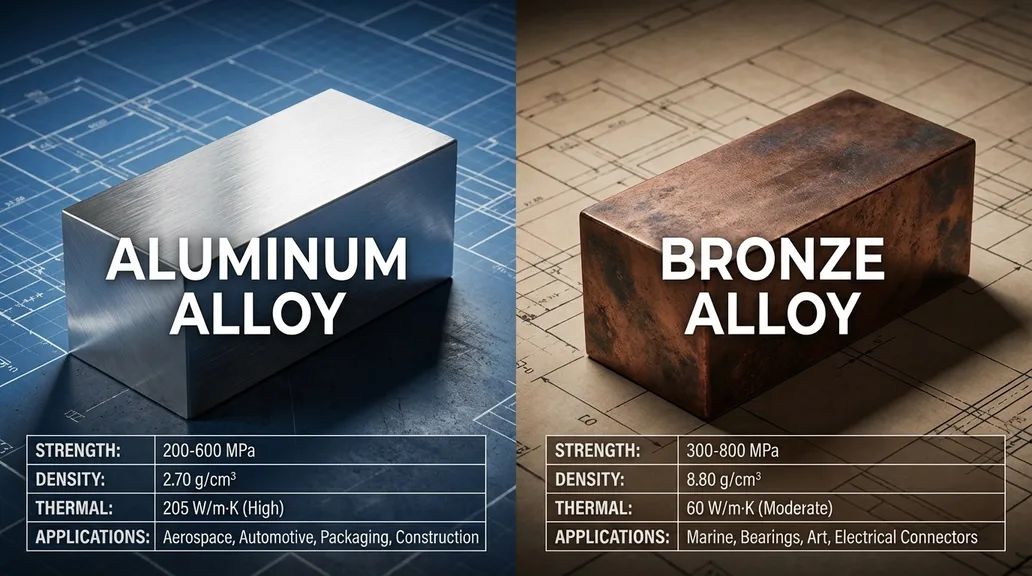
The “Fast Choice” Rule
- Choose Bronze for heavy loads, continuous friction, low speeds, and components where lubrication might be sparse.
- Choose Aluminum for structural housings, high-speed low-load rotating parts (when anodized), and weight-critical aero components.
Operating Conditions First
Before you pick a material, check these 6 critical parameters. If more than 3 point to ‘High,’ Bronze is your only safe bet.
Jason’s Field Logic:
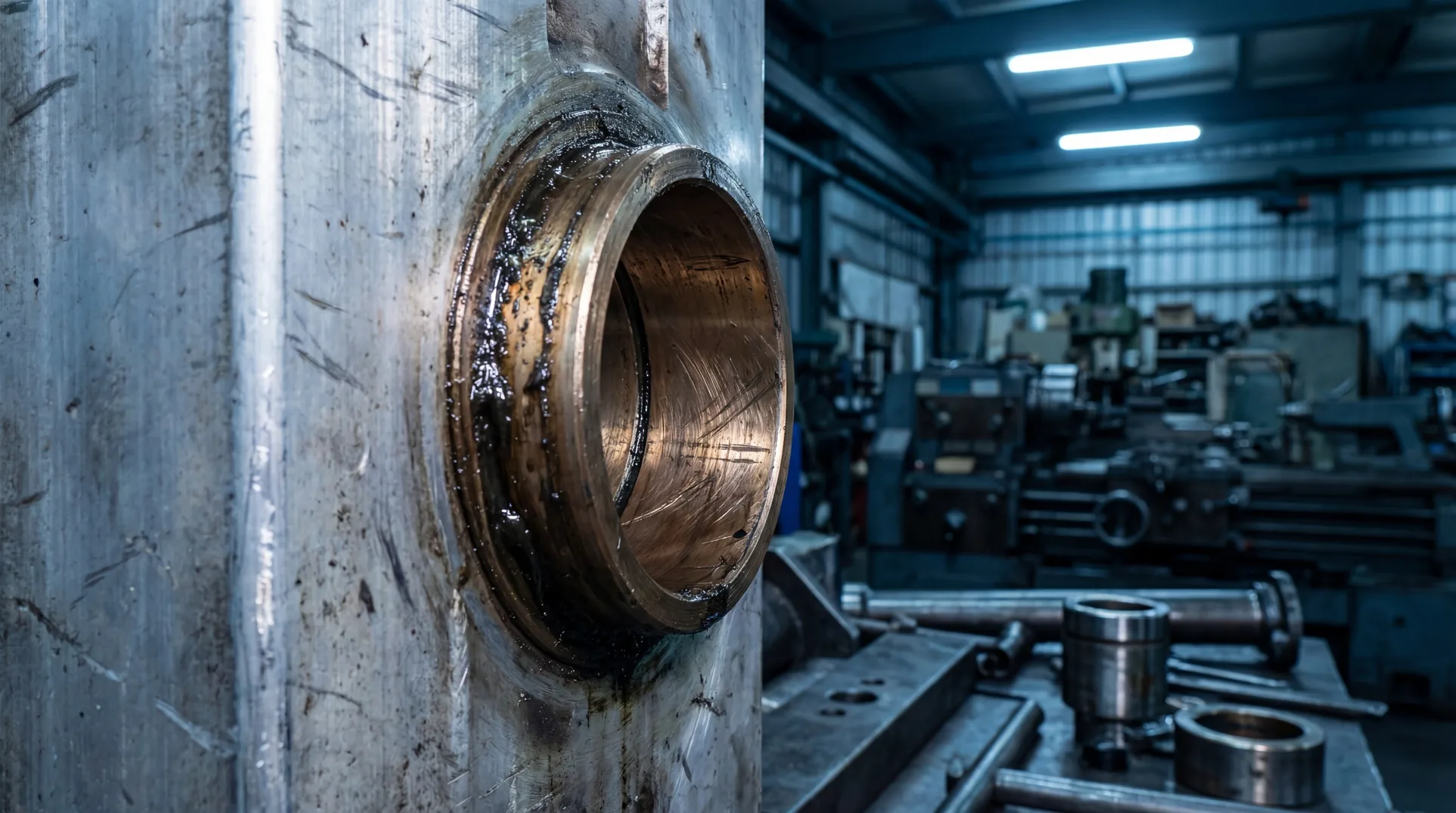
“Aluminum is notorious for Galling. If your operating speed is high but the load is low, a hard-anodized Aluminum might work. But if you have heavy shock loads—like in a hydraulic cylinder head or a ship’s winch—Bronze’s natural lubricity and high compressive strength are non-negotiable.”
Consult an EngineerThermal Expansion & Clearance: A DFM Critical
One of the biggest mistakes I see in DFM reviews is ignoring Differential Thermal Expansion. Aluminum has a Coefficient of Thermal Expansion (CTE) ~23.1 µm/m·K, while Bronze is ~18.0 µm/m·K.
The 100°C Delta Scenario:
If you press-fit a Bronze bushing into an Aluminum housing: When the system heats up by 100°C, the Aluminum hole expands 30% faster than the Bronze bushing.
The Result? The interference fit loosens, the bushing may rotate or “walk” out of the housing, leading to catastrophic machine failure.
Bushing Clearance for High Temp
Understanding Wear Mechanisms & Patterns
Adhesive Wear (Galling)
Occurs when surface asperities “weld” together. Aluminum is highly susceptible unless using Al-Sn bearing alloys. Bronze acts as a solid lubricant to prevent this.
Abrasive Wear
Caused by hard particles cutting the surface. Aluminum 6061 has low resistance; Aluminum Bronze (C954) is specifically engineered to resist this.
Fatigue Pitting
Cyclic loading causes surface cracks. Bronze’s superior fatigue strength makes it the global standard for heavy machinery pivots and linkages.
Cast vs. Sintered Bronze: Know the Difference
Cast Bronze (C932 / C954)
- High Load Capacity: Up to 4000 PSI.
- Requires external lubrication (grease/oil).
- Best for: Construction equipment, heavy valves.
Sintered Bronze (Oilite)
- Porous structure impregnated with oil.
- Self-Lubricating: Ideal for “sealed for life” units.
- Best for: Home appliances, high-speed small motors.
Total Cost of Ownership (TCO) Analysis
While the initial material cost of Bronze is 3x to 5x higher than Aluminum, focusing only on the purchase price is a procurement trap. In high-wear environments, the “Life Cycle Factor” dramatically shifts the ROI.
Jason’s TCO Rule: “If a machine’s downtime cost exceeds $1,000/hour, saving $50 on an aluminum pivot is an engineering failure. Bronze’s 5x longer life cycle and reduced downtime make it the cheaper option over a 2-year horizon.”
Comparison Table 1: Performance & Manufacturing
| Property | Aluminum (6061-T6) | Bronze (C932 / C954) | The “Engineer’s Edge” |
|---|---|---|---|
| Friction Coeff (Dry) | ~0.8 (High) | ~0.15 – 0.25 (Low) | Bronze self-lubricates; Al-Sn alloys are the only Al exception. |
| CTE (Thermal Exp) | 23.1 µm/m·K | 18.0 µm/m·K | Aluminum expands ~1.3x faster than Bronze. |
| Hardness (Brinell) | 95 HB | 170 – 195 HB (Al-Bronze) | Bronze resists surface deformation better. |
| Corrosion (Marine) | Moderate (Needs Anodizing) | Excellent (Natural) | Bronze is the king of saltwater. |
| Machinability | Excellent (High SFM) | Good (Chip control is key) | Aluminum is faster to machine. |
| Cost Factor | 1x (Baseline) | 3x – 5x (Premium) | Initial cost vs. Replacement frequency. |
Comparison Table 2: Typical Parts Matchup
| Component Type | Recommended Material | Primary Reason |
|---|---|---|
| Heavy-Duty Bushings | Bronze (C932) | Load capacity & lubricity. |
| Gearbox Housings | Aluminum (7075) | Heat dissipation & weight. |
| Marine Propeller Parts | Al-Bronze (C954) | Cavitation & salt resistance. |
| Worm Gears | Bronze (Phosphor) | Wear resistance against steel. |
| Pneumatic Cylinders | Aluminum (Anodized) | Lightweight reciprocating mass. |
Bushing Design Tips: The “Jason Protocol”
1. Clearance & Fit
For Bronze bushings, I usually aim for a H7/f7 fit. Aluminum expands more with heat, so if you’re using an Aluminum housing with a Bronze bushing, increase your interference fit to account for the differential thermal expansion.
2. Surface Roughness
Don’t over-polish! A surface that’s too smooth (Ra < 0.2) won’t hold an oil film. Aim for Ra 0.4 to 0.8 for the shaft to ensure the hydrodynamic wedge stays intact.
3. Grooving Patterns
If you have continuous rotation, use a circular groove. For oscillating motion, use a “Figure-8” or “Double Loop” pattern. This is critical for Bronze to distribute grease evenly.
4. Chamfering
Always include a 45-degree lead-in chamfer on the ID and OD. I’ve seen too many Aluminum parts scored during assembly because of sharp, square edges on a press-fit bushing.
Failure Stories I’ve Seen
A customer used 6061 Aluminum for a heavy hinge pin pivot to save weight. Result: After 48 hours of operation, the aluminum galled and “cold-welded” to the steel pin, snapping the motor shaft.
Solution: Replaced with C932 Bronze bushing.
An offshore sensor mount was made from Aluminum to reduce cost. Result: Despite anodizing, crevice corrosion at the thread interface made the unit impossible to disassemble for maintenance.
Solution: Switched to Aluminum Bronze (C954).
A high-speed slider was made from Aluminum to match the frame material. Result: Abrasive dust in the environment acted like sandpaper, wearing down the aluminum by 0.5mm in just a week.
Solution: Hard-Anodized Aluminum + Bronze Wear Plate.
Rapidaccu Manufacturing Solutions
Need a material consultation?
Our engineers help you choose the right alloy for your wear application.
Frequently Asked Questions
Are there any aluminum alloys that don’t gall?
Yes, specialized **Bearing Aluminum Alloys** (like A380 or Al-Sn alloys) are engineered with tin or silicon to provide lubricity. However, these are typically used in engine bearings and are not common for general CNC machined structural parts like 6061.
How do I calculate bushing clearance for high temps?
You must account for the difference in Coefficient of Thermal Expansion (CTE). Since aluminum expands ~1.3x more than bronze, a press-fit bushing will loosen as the temperature rises. We recommend a tighter initial interference fit (approx +0.005mm/10mm dia) for high-temp assemblies.
Is Aluminum or Bronze better for salt water?
Bronze, specifically Aluminum Bronze (C954), is vastly superior. It forms a protective oxide layer that resists chloride attack, whereas Aluminum requires high-grade marine anodizing and even then is prone to pitting.
Can I use Aluminum as a bearing material?
Only if it is hard-anodized or has a PTFE coating, and even then only for low-load applications. Raw aluminum will gall against almost any other metal surface under load.
Which material is easier to machine?
Aluminum (6061) is easier and faster to machine, which lowers production costs. Bronze is denser and tougher on tools, requiring slower speeds and specialized cooling.
What is the weight difference between the two?
Bronze is approximately 3 times heavier than Aluminum. If weight is a primary constraint, engineers often use Aluminum housings with thin-walled Bronze bushings.
Why is Bronze used for worm gears?
Worm gears involve high sliding friction. Bronze’s low coefficient of friction and high wear resistance prevent the gears from seizing against the steel worm.
Does Bronze need constant lubrication?
While all metallic bearings perform better with lubrication, “Oilite” or sintered bronzes are impregnated with oil, making them suitable for maintenance-free applications.
What is “Galling” in Aluminum?
Galling is a form of wear caused by adhesion between sliding surfaces. In Aluminum, this often leads to the metal “smearing” and seizing up the entire assembly.
Can Aluminum Bronze replace Stainless Steel?
In many marine and heavy-load bearing applications, yes. It has comparable strength and often better anti-fouling properties in saltwater environments.
Ready for a Precise Quote?
Upload your CAD files today. Our engineering team, led by Jack, will review your design for manufacturability and provide a technical cost analysis within 24 hours.
Email Us
info@rapidaccu.comOur Headquarters
Shenzhen, China