
Aluminum vs Stainless Steel: An Engineer’s Decision Guide
Choosing between aluminum and stainless steel is more than just cost—it’s about mechanical integrity, environmental survival, and manufacturing feasibility.
[Image Placeholder: Professional headshot of Jack in a manufacturing environment]
Jack
Senior Manufacturing Engineer
15 Years at Rapidaccu
15 Years of Metal Chips: My Perspective
In my 15 years on the floor at Rapidaccu, I’ve seen thousands of projects succeed or struggle based on one initial choice: the material. I’ve watched engineers specify Stainless Steel 304 for lightweight drones, and seen Aluminum 6061 fail in marine environments within weeks.
My goal today isn’t to give you a marketing brochure. I want to give you the same advice I give my clients during a DFM (Design for Manufacturing) review. Whether we are doing aluminum machining or stainless steel machining, the right choice starts with understanding the fundamental trade-offs.
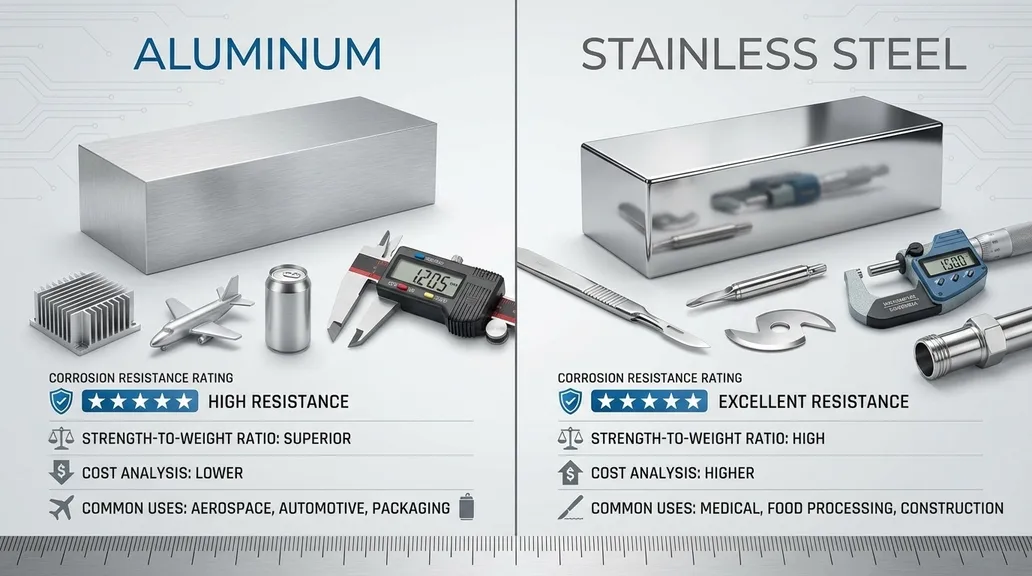
Aluminum vs Stainless Steel Properties Comparison
| Property | Aluminum (e.g., 6061-T6) | Stainless Steel (e.g., 304/316) |
|---|---|---|
| Density | ~2.7 g/cm³ (Lightweight) | ~7.8 – 8.0 g/cm³ (Heavy) |
| Strength (Tensile) | 240 – 310 MPa | 515 – 860 MPa (High Strength) |
| Corrosion Resistance | Good (Forms protective oxide layer) | Excellent (Especially 316 in marine/chemical) |
| Thermal Conductivity | High (~167 W/m·K) – Great for heat sinks | Low (~16 W/m·K) – Heat stays localized |
| Machinability | Excellent (Fast speeds, low tool wear) | Challenging (Work hardening, higher wear) |
| Weldability | Moderate (Requires skill/special gas) | Excellent (Highly predictable) |
| Surface Finish | Anodizing, powder coating, bead blast | Electropolishing, passivating, brushing |
| Raw Material Cost | Generally lower per volume | Higher (Significant alloy content) |
| Lead Time Risk | Low (Common stock) | Moderate (Special grades take time) |
Beyond Machining: Our Full Manufacturing Suite
At Rapidaccu, we don’t just mill and turn. We provide end-to-end solutions using both materials across various processes. Whether it’s complex aerospace housings or precision medical components, our integrated approach ensures consistent quality from prototype to production.
Engineering Decision Tree: If/Then Rules
IF: Weight is the critical constraint (Aerospace/Robotics)
THEN: Choose Aluminum. It offers the best strength-to-weight ratio for most mobile applications.
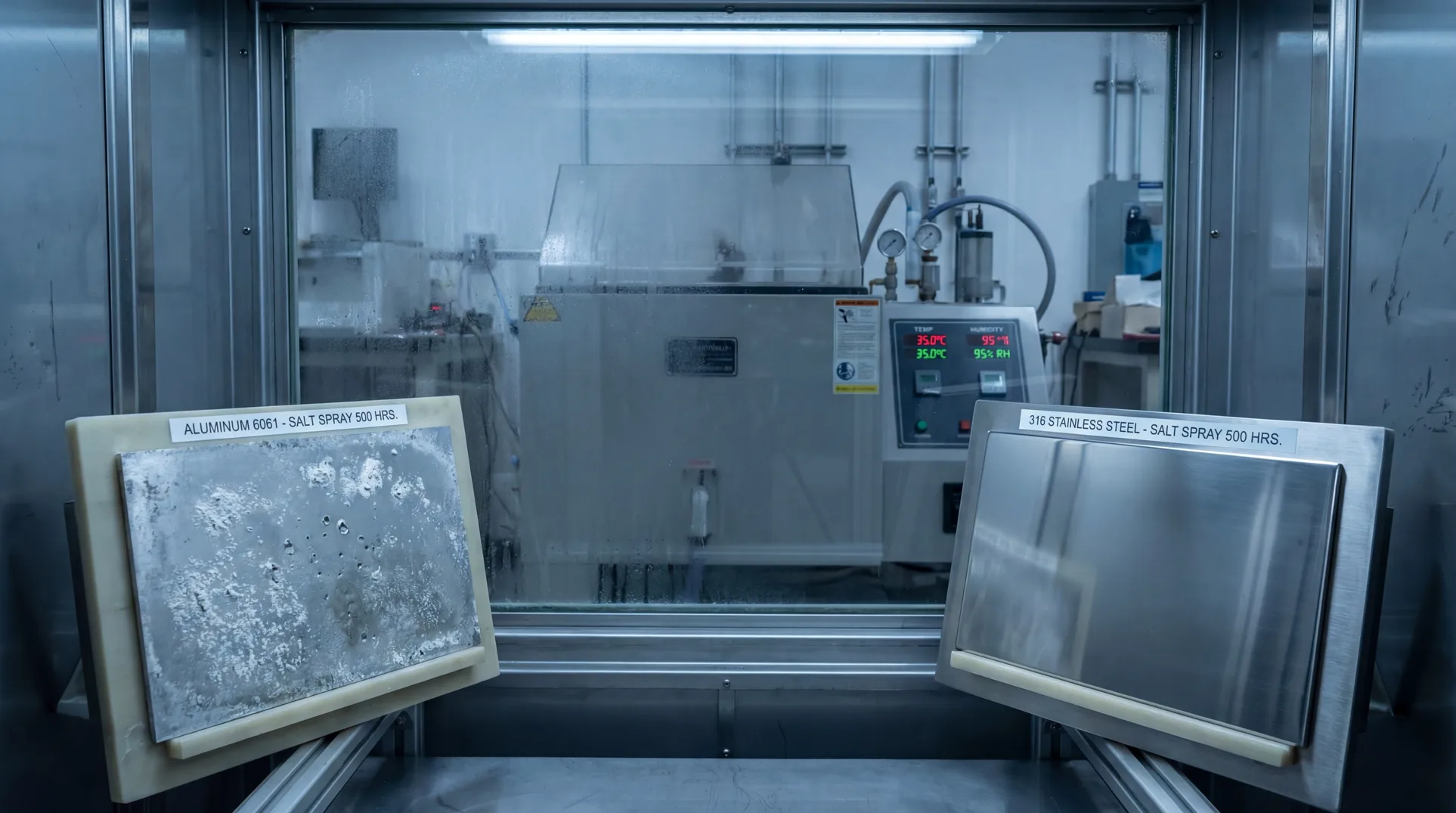
IF: The environment involves salt water or harsh chemicals
THEN: Choose Stainless Steel 316. Aluminum will pit and corrode without expensive coatings.
IF: Food-grade or medical sterilization is required
THEN: Choose Stainless Steel 304/316. Its non-porous surface resists bacterial growth and withstands cleaning.
IF: Total cost (Material + Machining) is the primary driver
THEN: Choose Aluminum. It’s faster to machine, reducing labor and machine time costs significantly.
IF: High thermal conductivity or heat dissipation is needed
THEN: Choose Aluminum. It’s the standard for heat sinks and thermal management components.
IF: High impact strength or hardness is required
THEN: Choose Stainless Steel. It is far more resistant to denting and surface wear than aluminum.
IF: Magnetic properties are either required or must be avoided
THEN: Aluminum is non-magnetic. Most 300-series Stainless is non-magnetic, but 400-series is magnetic.
IF: A vibrant, colorful aesthetic is desired
THEN: Choose Aluminum for Anodizing. Stainless cannot be anodized in the same way.
Application Scenarios: Where They Excel
| Application | Recommended Material | Engineering Rationale |
|---|---|---|
| Outdoor Telecom Housing | Aluminum (Anodized) | Weight savings on poles + corrosion resistance via anodizing. |
| Food Processing Blades | Stainless Steel 420/440 | High hardness for edge retention + food safety compliance. |
| Marine Deck Hardware | Stainless Steel 316 | Molybdenum content prevents chloride pitting in sea air. |
| Internal Structural Brackets | Aluminum 6061 | Highest “bang for buck” for non-exposed structural parts. |
| Electronic Heat Sinks | Aluminum 1050/6063 | Superior thermal conductivity compared to steel. |
| Luxury Watch Cases | Stainless Steel 316L | Hypoallergenic properties and premium “heft” feel. |
Manufacturing Feasibility (DFM): The Pro’s Notes
Aluminum Machining Notes
- Tooling: Use carbide tools with high rake angles to prevent “built-up edge” (material sticking to the tool).
- Deformation: Thin-walled aluminum parts are prone to warping due to internal stress release. Always specify stress-relieved grades for precision parts.
- Thread Strength: Aluminum threads are soft. For high-cycle fastening, I always recommend Helicoil inserts to prevent stripping.
- Burrs: Aluminum produces soft burrs. While easy to remove, they can hide in deep pockets.
Stainless Steel Machining Notes
- Work Hardening: If the tool dwells or rubs, the surface hardens instantly. You must maintain constant chip load.
- Heat Management: Stainless has poor thermal conductivity. The heat goes into the tool, not the chip. High-pressure coolant is a must.
- Post-Weld Distortion: Stainless expands significantly when heated. Large weldments will bow if not properly jigged or stress-relieved.
- Surface Passivation: After machining, stainless must be passivated to restore its corrosion resistance by removing free iron from the surface.
“The biggest mistake I see? Engineers designing stainless steel parts with the same tight tolerances as aluminum. Stainless is harder on the machines and the tools—give it some ‘breathing room’ where possible.” – Jack
Common Errors & How to Fix Them
Error 01: Over-specifying Stainless
Specifying 316 stainless for indoor, dry environments where aluminum would suffice.
FIX: Use Aluminum 6061 and save 40-60% on total cost.
Error 02: Ignoring Galvanic Corrosion
Bolting aluminum and stainless parts together in a wet environment.
FIX: Use nylon washers or specify a matching material set.
Error 03: Blind Holes in Stainless
Designing deep blind-tapped holes in 304 stainless without chip clearance.
FIX: Increase hole depth or use through-holes where possible.
Error 04: Anodizing Wrong Alloys
Trying to decoratively anodize high-silicon cast aluminum alloys.
FIX: Stick to 6000 or 7000 series for decorative finishes.
Error 05: Sharp Internal Corners
Specifying zero-radius internal corners in stainless parts.
FIX: Allow for a corner radius equal to at least 1/2 tool diameter.
Error 06: Assuming All Stainless is Magnetic
Designing a magnetic sensor mount using 304 stainless, thinking it’s magnetic.
FIX: Specify 400-series (like 430) for magnetic applications.
Frequently Asked Questions
Which is cheaper, aluminum or stainless steel?
Is aluminum as strong as steel?
Can I weld aluminum to stainless steel?
Which material is better for heat sinks?
Does stainless steel rust?
Can aluminum be used for food contact?
What is the best aluminum alloy for CNC machining?
Why does stainless steel work-harden?
The Verdict: Making Your Choice
The “Generalist” Choice
Aluminum 6061-T6. If you don’t have extreme heat or extreme corrosion requirements, this is almost always the right starting point.
The “Harsh Environment” Choice
Stainless Steel 316. For marine, chemical processing, or medical implants, the extra cost of 316 is a necessary insurance policy against failure.
The “Performance” Choice
Aluminum 7075. When you need the strength of steel but the weight of aluminum, and the budget allows for it.
The Cost of a Wrong Choice
Choosing the wrong material isn’t just a line-item error. It leads to:
- Product Recalls: Corrosion failures in the field.
- Assembly Failures: Stripped threads in soft aluminum or warped stainless weldments.
- Margin Erosion: Spending 3x more on stainless when aluminum was perfectly adequate.
Let’s Review Your Drawings
Not sure which grade is right for your specific application? I personally review every complex DFM request that comes through Rapidaccu.
Rapidaccu Precision Manufacturing
Expert CNC Machining | Sheet Metal | 3D Printing
[Contact Form: 7 id=”00376c3″ title=”Request Quote”]