
Liquid Cooling Connector Manufacturer — Engineering-Driven, OCP-Oriented, Production Ready
Full-series coverage across quick disconnect, blind-mate, multi-circuit, and large-flow liquid cooling connectors. From prototype to volume production — one engineering team, one quality system, one supply chain.
OCP/ORv3 Ecosystem
Precision CNC Assembly
Verifiable Testing
Custom Interface & Material
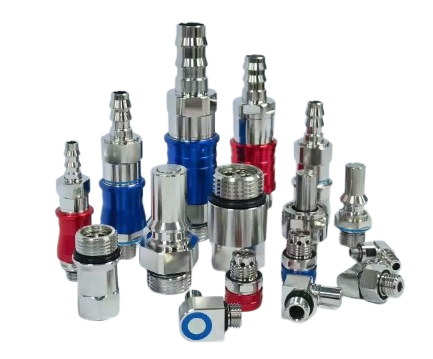
Liquid Cooling Connector Series Overview
Five product series covering every liquid cooling connection scenario — from universal quick disconnect to blind-mate, multi-circuit, and large-flow applications. Click any card to explore detailed specifications.
UQD
Universal Quick Disconnect
Industry-standard plug-and-play coupling for general-purpose liquid cooling maintenance points. Available in sizes 02–08 with inline and right-angle configurations.
UQDB
Blind-Mate Quick Disconnect
Extended blind-mate solution with 1 mm radial self-alignment and tool-free assembly. Designed for tight spaces where visibility and access are limited.
BMQC
Blind-Mate for Open Rack V3
Engineered specifically for OCP Open Rack V3 architecture with ±5 mm radial and ±2.7° angular misalignment tolerance. 100% helium-leak tested.
LQC
Large Quick Connector
20 mm nominal flow path with screw-to-connect locking and vibration resistance. Ideal for large cold-plate systems, high-flow trunk lines, and vibration-critical environments.
MQD
Multi Quick Disconnect
Ultra-small profile multi-circuit coupling for high-density compute trays. Multiple circuits in a single connection — minimizing footprint while maximizing flow and reducing assembly time.
How to Choose the Right Liquid Cooling Connector
Three decision criteria to narrow your selection. Use the comparison table below for detailed evaluation.
Blind-Mate Required?
If installers cannot see or reach the connection point, choose UQDB (general blind-mate) or BMQC (Open Rack V3 specific). Otherwise, UQD, LQC, or MQD offer direct-connect options.
Flow & Pressure Drop Target?
For large cold-plate loops requiring >15 LPM with minimal restriction, choose LQC (20 mm path). For standard compute tray flows, UQD or MQD delivers optimal performance-to-size ratio.
Multi-Circuit Needed?
If the application requires multiple fluid lines through a single coupling (e.g., supply + return in one plug), MQD provides the most compact multi-circuit solution with ultra-low pressure drop.
| Series | Best For | Key Advantages | Form / Installation | Selection Criteria |
|---|---|---|---|---|
| UQD | Universal quick-disconnect maintenance points | Quick plug-and-play, reliable sealing, dry-break | Standard footprint, inline/right-angle | General-purpose, cost/lead-time balanced |
| UQDB | Tight spaces with blind-mate assembly | 1 mm radial self-alignment, tool-free, high-cadence | Blind-mate tolerance window | No-visibility install, rapid takt time |
| BMQC | OCP Open Rack V3 architecture | ORv3 blind-mate, ±5 mm / ±2.7° tolerance, He-tested | ORv3 structural constraints | Project specifies ORv3 interface |
| LQC | Large cold-plates & high-flow trunk lines | 20 mm flow path, screw-lock, vibration-resistant | Screw-to-connect, panel/manifold | High flow, strong locking, anti-vibration priority |
| MQD | High-density compute tray multi-circuit | Ultra-small profile, multi-line, low pressure drop | Inline/right-angle, multi-port | Multi-circuit, density-sensitive, ΔP-critical |
Still unsure which series fits your application?
Typical System Architecture & Integration Positions
Understand where each connector series fits within a liquid cooling system — from rack-level distribution to tray-level service points and cold-plate connections.
Rack-Level Distribution
CDU → Manifold → Tray
The primary distribution backbone carries coolant from the CDU through rack manifolds to individual tray branches. Connection points at the manifold interface require reliable sealing and quick serviceability.
Tray-Level Service Point
Compute Tray Quick-Release
Compute trays require rapid hot-swap capability. Connectors at this level must enable tool-free insertion and removal while maintaining zero-spill integrity during disconnect.
Cold-Plate Primary Connection
Large Cold-Plate Inlet/Outlet
Large cold-plate systems demand high flow rates and vibration resistance. The primary connection at the cold-plate interface handles the full thermal load and must withstand continuous mechanical stress.
OCP ORv3 Ecosystem
Blind-Mate Interface Position
Open Rack V3 defines standardized blind-mate fluid connection positions within the rack structure. Connectors must accommodate the specified misalignment tolerances and integrate with ORv3 mechanical constraints.
Full Customization Capability Overview
Every parameter is project-configurable. From interface geometry to seal material to surface treatment — we engineer to your specification, not a catalog default.
Interface & Termination
Barb for flexible tubing, threaded (NPT/G/M) for rigid systems, manifold-integrated ports, or fully custom transition adapters.
- Barb / Threaded / Manifold
- Custom transition geometry
- Thread specification per project
Layout & Envelope
Inline (straight-through), right-angle, or custom-angle routing to fit your mechanical packaging constraints.
- Inline / Right-angle / Custom
- Envelope optimization per space
- Panel / manifold mount options
Sealing & Material
Seal material (EPDM, FKM, NBR) selected per coolant chemistry. Body in stainless steel, aluminum, brass, or engineered plastic.
- EPDM / FKM / NBR seals
- SS / AL / Brass / Plastic body
- Media-compatible selection
Surface Treatment
Corrosion protection and functional coatings tailored to your operating environment and compliance needs.
- Anodize / Nickel plating
- Passivation / Electropolish
- Custom coating per spec
Anti-Mismate & Guidance
Keying, alignment guides, and polarization features to prevent incorrect mating — especially critical for blind-mate and multi-circuit designs.
- Keying / polarization pins
- Guide funnel geometry
- Blind-mate tolerance window
Documentation & Deliverables
Full engineering documentation package available — from FAI to traceability records, formatted to your acceptance requirements.
- FAI / Inspection reports
- Batch traceability records
- Material certs & compliance
For detailed customization parameters per series, visit each product page’s dedicated Customization Table section.
Discuss Custom RequirementsFrom Requirement to Volume Production
A structured, milestone-driven engineering process that takes your specifications from initial concept through DFM, prototyping, validation, and production ramp.
A Input Information Template
Flow & Pressure Drop Target
Required flow rate (LPM), maximum allowable ΔP, operating pressure
Temperature & Media
Operating temperature range, coolant type (water, glycol, dielectric fluid)
Space Envelope & Interface
Available packaging volume, mounting method, mating interface geometry
Installation Tolerance & Vibration
Alignment tolerance budget, vibration/shock profile, assembly deviation
Volume & Timeline
Annual estimated quantity, project phase, target SOP date
B Development Milestones
Requirement Review & DFM Analysis
Tolerance chain analysis, sealing surface review, assembly feasibility, cost breakdown
Prototype Build (T1 Samples)
First-article prototypes with dimensional report, functional verification
Validation & Test
Pressure, leak, flow, cycle-life, vibration testing per agreed test plan
Pilot Run & Process Lock
Small-batch production validation, process parameter freeze, tooling finalization
Volume Production Ramp
Full-scale manufacturing with SPC monitoring, batch traceability, ongoing quality reporting
Change Management Built In
Version-controlled drawings, ECN tracking, and document consistency across all revisions. Engineering changes are systematically managed to prevent production discrepancies.
Key Performance Verification & Testing Capability
Every connector undergoes rigorous validation against your performance specification. We deliver test data — not just parts.
Leak & Seal Integrity
- Air-under-water leak test
- Helium mass-spectrometer test (BMQC)
- Pressure-hold decay test
- Burst pressure validation
Flow & Pressure Drop
- Cv/Kv flow coefficient measurement
- ΔP vs. flow-rate curve generation
- CFD simulation support (upon request)
- Bench-test correlation validation
Cycle Life & Durability
- Connect/disconnect cycle testing
- Vibration endurance (random/sine)
- Thermal cycling fatigue
- Accelerated aging & material soak
Dimensional & CTQ Inspection
- CMM measurement of sealing surfaces
- Coaxiality & concentricity verification
- Thread gauge go/no-go checks
- Surface roughness Ra measurement
Deliverable Documentation
- Test plan (agreed before build)
- Test report with raw data
- Batch inspection records
- Material certification & traceability
Why We Deliver Consistent Quality at Scale
Precision CNC machining, controlled assembly processes, and in-line inspection ensure every connector meets specification — from prototype through volume production.
Precision CNC Machining
- 3-axis, 4-axis, and 5-axis CNC centers for complex sealing geometries
- Sealing face surface finish control to Ra ≤ 0.4 μm
- Flow path internal finish optimization for low ΔP
- Coaxiality control within ±0.01 mm on critical features
Secondary Processes
- Surface treatment: anodize, nickel plating, passivation, electropolish
- Precision cleaning per particle count requirements
- Dust-proof plugging and cleanroom-compatible packaging
- Laser marking for serial/batch traceability
Production Consistency
- Dedicated tooling and fixtures per product configuration
- In-process inspection gates at critical operations
- SPC monitoring on CTQ dimensions and seal performance
- Supply chain engineering responsibility retained by Rapidaccu
15+ Years Precision Manufacturing Experience
Proven track record in fluid connector machining, assembly, and quality assurance for demanding applications.
Quality System & Full Traceability
Delivery certainty starts with incoming material control, flows through process inspection, and ends with batch-traceable documentation your procurement team can rely on.
Incoming Inspection
- Material certificate verification (mill certs)
- Raw material dimensional check
- Seal/O-ring material & hardness test
Process Control
- In-process CTQ gauge checks
- Surface treatment parameter log
- Assembly torque & function verification
Batch Traceability
- Serial/batch number per unit
- Inspection record archival
- Full material-to-shipment chain
Customer Acceptance
- FAI package per customer format
- Report format adaptation (AS9102, PPAP)
- Compliance document support (RoHS, REACH)
Application Industries & Use Cases
Our liquid cooling connectors serve thermal management challenges across multiple high-reliability sectors.
Data Center & AI Server Liquid Cooling
Primary FocusHigh-density GPU/CPU clusters, AI training infrastructure, and hyperscale compute deployments requiring reliable, high-flow liquid cooling with rapid serviceability.
TYPICAL ENGAGEMENT
Challenge: Thermal design requiring zero-spill disconnect for hot-swap server trays with <5 kPa pressure drop.
Solution: UQD/UQDB series with custom barb termination, validated through 10,000+ cycle life and helium leak testing.
Result: Leak-free operation across 3 production batches; 2-week sample lead time; full traceability documentation.
Power Electronics & Energy Storage
Growing SectorIGBT modules, battery thermal management systems, and high-power inverter cooling requiring chemical-resistant seals and vibration-proof connections.
TYPICAL ENGAGEMENT
Challenge: Glycol-based coolant loop with continuous vibration and 150 psi operating pressure.
Solution: LQC screw-lock coupling with FKM seals and stainless steel body, vibration-tested per IEC profile.
Result: Zero field failures over 18 months; custom surface finish for corrosion resistance.
Industrial Thermal Management
Specialty ApplicationsLaser systems, medical imaging equipment, and industrial process cooling with strict cleanliness and material compatibility requirements.
TYPICAL ENGAGEMENT
Challenge: DI-water cooling loop for precision laser with zero particulate contamination tolerance.
Solution: Custom UQD with electropolished wetted surfaces, precision-cleaned and packaged per Class 100 protocol.
Result: Particle count verified below customer threshold; NDA-protected design delivered in 4 weeks.
Robotics & Automated Systems
EmergingHigh-motion robotic platforms and automated production equipment where connectors must withstand repeated mating cycles, shock loads, and tight routing constraints.
TYPICAL ENGAGEMENT
Challenge: Robotic arm cooling with 50,000+ mating cycles and multi-axis movement constraints.
Solution: MQD multi-circuit with custom right-angle routing, reinforced latch mechanism for shock resistance.
Result: Cycle life validated at 60,000+ cycles; custom dust cap integrated per customer specification.
Frequently Asked Questions
Answers to the most common questions about selection, integration, validation, and procurement of our liquid cooling connectors.
Q1 I’m not sure whether to choose UQD, UQDB, MQD, or LQC — how do I decide?
Q2 Does an ORv3 project always require BMQC? How do you handle compatibility review?
Q3 What parameters do I need to provide for pressure drop and sealing evaluation?
Q4 What test reports and traceability documents can you provide?
Q5 What are your sample, pilot, and volume production lead times and MOQ?
Q6 How many prototype rounds does a custom development project typically require?
Start Your Liquid Cooling Connector Project
Upload your drawings, share your interface specifications, or describe your application requirements. Our engineering team responds within 24 hours with series recommendation, DFM assessment, and preliminary quotation.
Address
Rongli Industrial Park, Dalang, Longhua District, Shenzhen, China
What to include in your inquiry
- Interface drawing or 3D model (if available)
- Flow rate, pressure, temperature requirements
- Space envelope and mounting method
- Estimated annual volume and timeline
- Applicable standards or compliance needs