
Types of Iron Explained:
Cast vs. Wrought vs. Pure
A practical guide to carbon content, mechanical properties, and machining strategies for 2026 engineering projects.
People searching for types of iron usually want more than definitions. They want to know what’s different, which one fits their part, and what it means for machining tolerances, cost, and reliability.
This guide explains the major types of iron used in engineering—pure iron, wrought iron, and cast irons (gray, ductile, white, malleable, CGI)—with carbon content boundaries, typical mechanical property ranges, and practical manufacturing notes to help you make informed decisions.
Iron vs. Steel vs. Cast Iron: The Carbon Boundary
The simplest way to classify “iron materials” is by carbon content (C%). Carbon isn’t just an additive; it fundamentally changes whether the material sits as graphite (soft, dampening) or carbides (hard, brittle).
- Commercially Pure Iron Typically ≤0.02% C. Very ductile, magnetic, low strength. Used for magnetic cores.
- Steel 0.008% to 2.14% C. The vast majority of structural metal. Wide property range via heat treatment.
- Cast Iron 2.14% to 6.67% C (Commonly 2.5%–4.0%). Excellent castability due to lower melting points. Graphite largely defines the behavior.
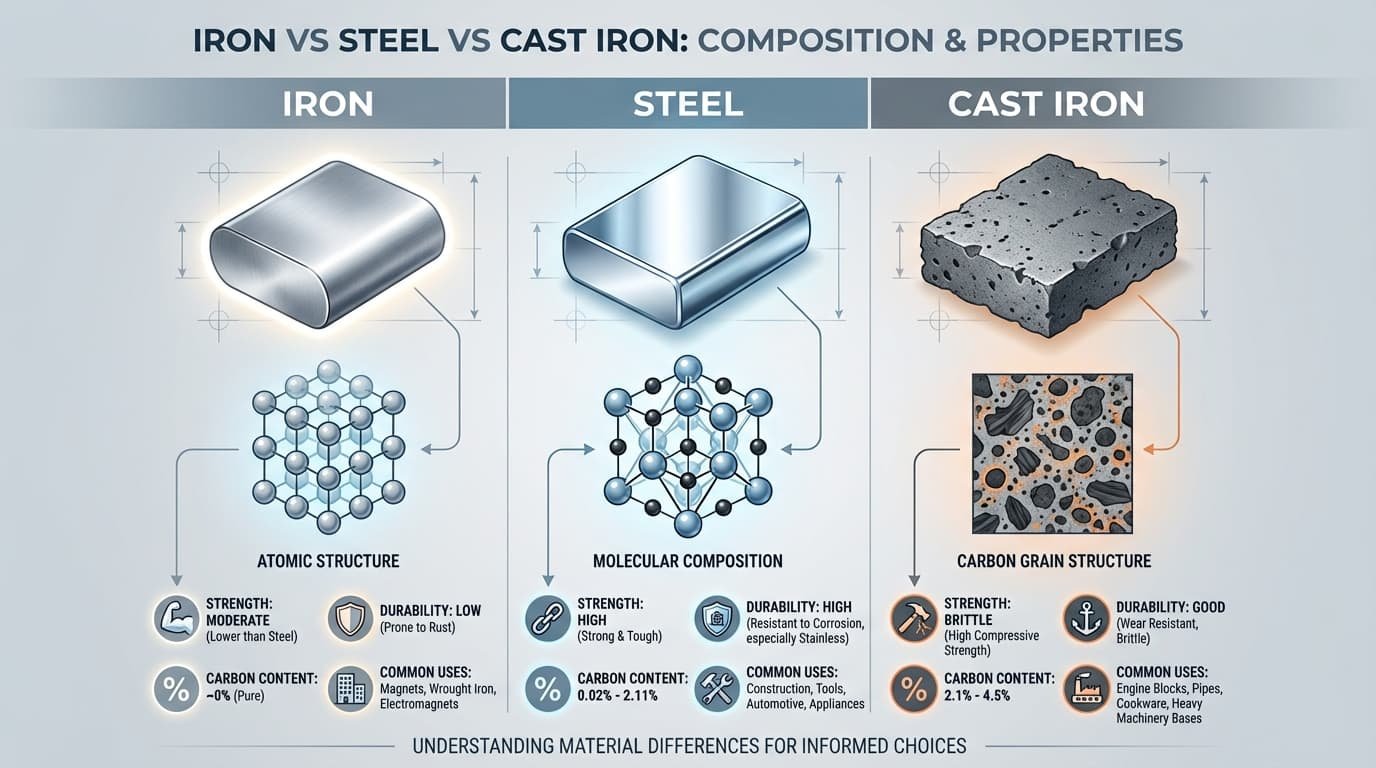
IRON VS STEEL VS CAST IRON: COMPOSITION & PROPERTIES
Quick Comparison: Main Types of Iron (With Real Engineering Data)
Table A — Practical comparison (typical ranges)
A side-by-side look at the mechanical reality of these materials.
*Ratings: 1 = Low, 5 = High.
| Type | Typical C% | Structure | Tensile (MPa) | Machinability (1-5) | Damping (1-5) |
|---|---|---|---|---|---|
| Pure Iron | ≤0.02 | Ferrite | 200-300 | 3 | 2 |
| Gray Cast Iron | 2.5-4.0 | Flake Graphite | 140-350 | 5 (Best) | 5 (Best) |
| Ductile Iron | 3.2-4.0 | Nodular Graphite | 414-827 | 3-4 | 3 |
| CGI | 3.0-4.0 | Vermicular | 350-500+ | 2-3 | 4 |
| White Iron | 2.0-3.6 | Carbides | 200-600 (Brittle) | 1 (Worst) | 1-2 |
| Malleable | 2.0-2.9 | Temper Carbon | 350-550 | 3-4 | 2-3 |
Table B — Engineering Application Selection (Practical Use-Cases)
Use this table to map real part requirements (damping, toughness, wear, pressure tightness, etc.) to the most common iron families. Final selection should be validated against your specific standard/grade and section thickness.
| Application / Part Example | Primary Driver | Recommended Iron Type(s) | Why It Fits | Manufacturing Notes (DFM / Machining / QC) |
|---|---|---|---|---|
| Machine tool base, fixture plate, vibration-sensitive frame | Vibration damping + dimensional stability | Gray Cast Iron | Excellent damping helps reduce chatter and improve surface finish stability. | Define machining datums early; request flatness/parallelism inspection on critical faces. |
| Pump housing, valve body, manifold (pressure-containing) | Pressure tightness + sealing surfaces |
Gray Cast Iron
Ductile Iron
|
Both are common for housings; ductile offers higher toughness if shock loads occur. | Plan for porosity control and leak paths; machine sealing faces last; specify material certs + dimensional report. |
| Automotive bracket, knuckle-like cast component, safety-relevant mount | Toughness + fatigue resistance | Ductile Iron | Better impact and fatigue behavior than gray iron for dynamic loads. | Clarify grade/heat treatment; control critical fillets and radii; consider FAI + traceability for programs with PPAP-like needs. |
| Gears, hubs, shafts with cast features | Strength + wear performance | Ductile Iron | Supports higher loads; can be specified in grades suitable for drivetrain-type parts. | Define gear tooth finishing route (hob/shape/grind); align hardness targets with tooling strategy. |
| Engine block (high output / stiffness-critical), high-load cylinder structure | Stiffness + thermal/mechanical loading | CGI (Compacted Graphite Iron) | Balances stiffness/strength with graphite-related benefits compared to typical ductile/gray choices. | Expect higher tool wear than gray iron; verify machining plan and inspection strategy for bore geometry. |
| Abrasive slurry handling, wear liner, chute plate, mixer wear components | Abrasive wear resistance | White Cast Iron | Carbide-rich structure provides strong abrasion resistance. | Design near-net; minimize machining features; plan grinding where needed; brittle—avoid impact load assumptions. |
| Threaded fittings, clamps, hardware needing some deformation tolerance | Ductility + reliability in small parts | Malleable Cast Iron | Heat treatment improves ductility versus typical gray iron in fitting-style parts. | Account for extra heat-treat step; confirm thread spec, gauges, and coating/finish requirements. |
| Decorative gates, restoration parts, traditional “wrought iron” look | Aesthetics + formability | Wrought Iron (Niche) | Chosen for legacy appearance and forming behavior (today often substituted). | Availability varies; confirm material authenticity requirements; coatings/paint system often drives durability more than base iron. |
| Magnetic components, electromagnets, magnetic yokes (low mechanical load) | Magnetic performance | Pure Iron | Low carbon and high purity can improve magnetic properties versus many steels/irons. | Confirm required magnetic specs; avoid over-tolerancing non-functional surfaces to control cost. |
| Precision-machined housings with tight bores, bearing seats, datum-critical assemblies | Geometric tolerances + repeatable machining |
Gray Cast Iron
Ductile Iron
|
Both are widely used for machined castings when the process is controlled. | Ask for CMM-based inspection reports on critical features; define casting allowances and machining stock clearly. |
| Prototype-to-production cast-and-machined programs (supplier consolidation) | Lead time + end-to-end accountability | Gray / Ductile + CNC Machining | A controlled workflow reduces redesign risk and improves delivery predictability. | Run DFM first (tolerances, datums, finish); standardize inspection criteria per batch; align change control before scaling. |
Deep Dive: Types of Cast Iron
Most Common 3.1 Gray Cast Iron (Flake Graphite)
Gray iron is characterized by graphite flakes that act as stress concentrators but also as chip breakers and vibration absorbers.
- Best for Damping: Ideal for machine bases and engine blocks.
- Machinability: Breaks into small chips easily; low tool wear.
- Weakness: Low tensile strength and brittle under impact.
3.2 Ductile (Nodular) Cast Iron
By adding magnesium, the graphite forms into spheres (nodules) rather than flakes. This simple change eliminates the crack-propagation paths found in gray iron.
Why Engineers Choose It:
Much higher tensile strength and ductility (elongation). It bridges the gap between the castability of gray iron and the strength of steel. Used for crankshafts, heavy-duty gears, and suspension components.
3.3 CGI (Compacted Graphite)
The middle ground. Stiffer than gray iron but retains some damping. Used in high-performance diesel engine blocks where weight reduction is critical. Harder to machine.
3.4 White Cast Iron
Carbide-dominant. Extremely hard and wear-resistant but virtually impossible to machine (must be ground). Used for liners in cement mixers and mining crushers.
3.5 Malleable Iron
White iron that has been heat-treated to convert carbides into “temper carbon.” Tougher than gray iron, used for pipe fittings and hardware.
What About Pure & Wrought Iron?
Pure Iron
Commercially pure iron (99.8%+) is soft and weak. It is rarely used for structural parts.
Primary Use: Magnetic cores, solenoids, and chemical standards where magnetic permeability is key.
Wrought Iron
Historically important but effectively obsolete in modern manufacturing. It contains slag fibers that give it a “wood grain” look.
Primary Use: Heritage restoration and decorative blacksmithing. Modern “wrought iron” fences are usually just mild steel.
Selection Checklist: How to Choose?
Start from the function of the part, not the material name.
Is there shock load or impact?
If YES → Choose Ductile Iron or Steel. Gray iron will crack.
Is vibration damping critical?
If YES → Choose Gray Iron. It dampens vibration 5-10x better than steel.
Is abrasive wear the main failure mode?
If YES → Choose White Iron, but ensure your design allows for grinding rather than milling.
Are tight tolerances required?
Both Gray and Ductile machine well, but you must plan for casting porosity and proper datums.
Machining Notes for Cost & Quality
Most iron parts are cast near-net shape and then CNC machined. The success of the part depends on how you handle the “skin.”
Plan Datums Early
Cast surfaces are rough and uneven. Designate specific “target points” for initial machining setup to ensure features are centered.
Expect Tool Wear
The casting “skin” often contains sand and oxides that are abrasive. The first cut is the hardest on tools.
Control the Dust
Cast iron produces fine powder chips, not strings. This carbon dust is conductive and can damage CNC electronics if extraction is poor.
Don’t Over-Tolerance
Do not put tight tolerances on non-functional cast surfaces. It forces expensive machining operations that add no value.
Need Custom Iron Parts?
If you’re selecting a material and want to ensure the part is manufacturable, cost-effective, and production-ready, an engineering review (DFM) can prevent expensive redesigns.
Rapidaccu is an engineering-driven custom parts manufacturer based in Shenzhen, China. We support global customers from rapid prototyping to mass production with 3/4/5-axis CNC machining, casting support, and full quality inspection.