
What is Fixtures & Jigs?
The Definitive Guide to Precision Tooling
Speed is important, but repeatability is king. Why the difference between “Good Enough” and “Six Sigma” often comes down to your workholding strategy.
More Than Just “Holders”
In the world of precision manufacturing, whether you are machining a complex aerospace component from Inconel 718 or assembling high-volume automotive sensors, the difference between a high-yield production run and a graveyard of scrapped parts often comes down to two critical tools: Fixtures and Jigs.
At Rapidaccu, we don’t just see fixtures and jigs as “holders.” We see them as the physical manifestation of process control. In this comprehensive guide, we will explore the technical nuances, the strategic ROI, and how the right tooling can stabilize your entire production line.
Defining the Core: Jigs vs. Fixtures
While often used interchangeably in casual conversation, in a professional machine shop, these terms describe two distinct functions.
What is a Jig?
A specialized tool that both holds the workpiece AND guides the cutting tool.
Its primary purpose is to ensure that the tool (like a drill bit or a tap) is positioned precisely relative to the part.
- Key Characteristic: Dictates the path/position of the tool.
- Example: A drill jig with hardened bushings ensuring holes are centered without marking.
What is a Fixture?
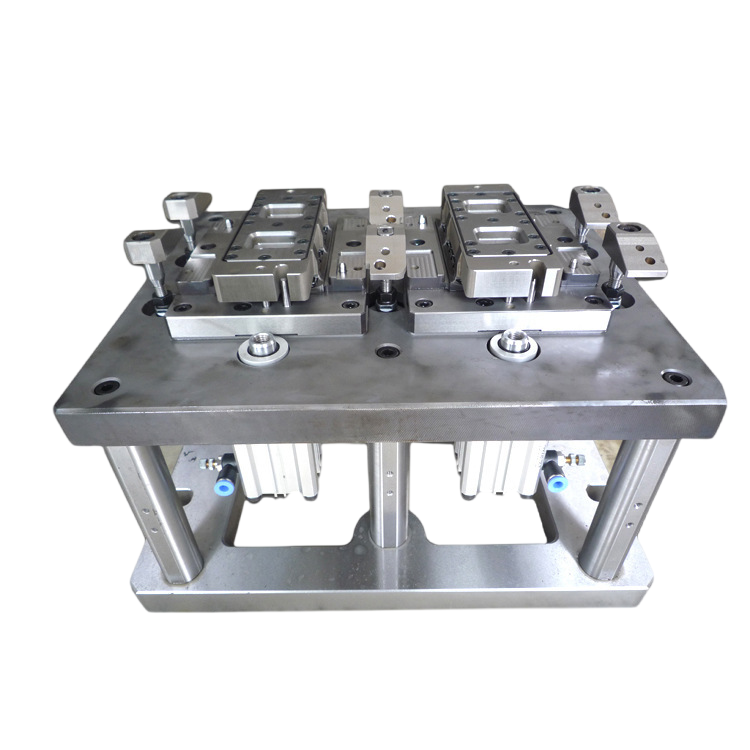
A tool that holds, supports, and locates the workpiece, but DOES NOT guide the cutting tool.
The tool’s movement is typically controlled by the CNC machine’s coordinate system or a manual operator.
- Key Characteristic: Ensures the part stays immobile and correctly referenced.
- Example: A 5-axis CNC milling fixture or a welding fixture to prevent distortion.
Why Custom Tooling is Non-Negotiable for B2B Success
Many manufacturers attempt to use “universal” workholding solutions to save costs. However, for precision industries like Semiconductor, Medical, and EV (Electric Vehicles), universal solutions often lead to vibration, chatter, and deformation—especially in thin-walled parts.
“The Rapidaccu Philosophy: A custom fixture is not a cost; it is an investment in Lower Takt Time and Audit-Ready Quality.”
The Anatomy of a High-Performance Fixture
In precision engineering, a high-quality fixture is far more than a simple block of metal. To ensure process stability and long-term reliability, professional engineers evaluate four critical technical elements:
A Locating Elements (3-2-1 Principle)
We utilize the 3-2-1 principle: 3 points on the primary base plane, 2 points on the secondary plane, and 1 point on the tertiary plane. This ensures every part loaded sits in the exact same spatial coordinates.
B Clamping Elements
The clamp must be strong enough to resist cutting forces but gentle enough not to deform the part. We specialize in Heat-Aware Clamping for welding and Sensitive-Surface Clamping for optics.
C Tool Guiding (For Jigs)
High-quality jigs use hardened steel bushings. These protect the jig from wear, ensuring that even after 10,000 cycles, the drill path remains true to within microns.
D The Body (The Foundation)
Whether cast iron, tool steel, or high-grade aluminum, the body must provide maximum damping to absorb CNC vibrations and prevent chatter.
Specialized Applications: Where Rapidaccu Excels

CNC Machining Fixtures (Milling & Turning)
In high-speed CNC machining, the fixture must handle extreme torque. We design Hydraulic and Pneumatic Fixtures for high-volume production, allowing for rapid loading and unloading, which significantly reduces “non-cutting time.”

Semiconductor & IC Test Fixtures
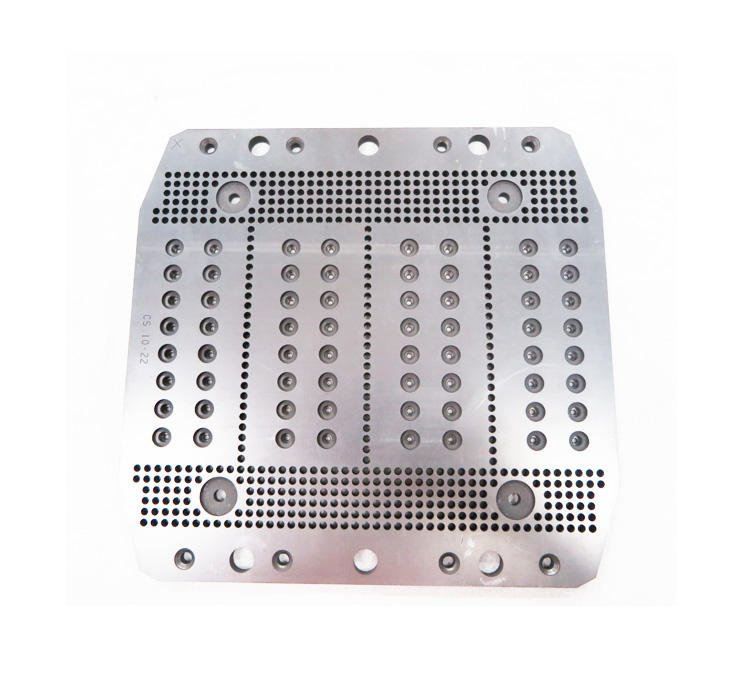
Semiconductor manufacturing requires more than just mechanical holding. Our fixtures focus on:
- ESD Control: Using dissipative materials (like PEEK-ESD).
- Cleanroom Compatibility: Utilizing materials that do not outgas.
Welding, Thermal & Metrology Jigs
Heat is the enemy of precision. Our welding jigs feature Heat Sinks and Expansion Gaps to allow for thermal growth. We also build CMM fixtures that ensure datums align perfectly with inspection probes, eliminating “false rejects.”
Material Selection for Fixtures & Jigs
Selecting the right material is a balance of durability, weight, and cost.
| Material | Characteristics | Best Application |
|---|---|---|
| Steel (4140, P20) | High hardness, extremely durable. | High-wear production environments. |
| Aluminum (6061-T6, 7075) | Lightweight, easy to machine. | Manual fixtures, low-stress jigs. |
| Stainless Steel (304, 316L) | Corrosion resistant, non-contaminating. | Medical devices, Food-grade equipment. |
| Invar 36 | Zero thermal expansion coefficient. | Aerospace composites, Optical bonding. |
The ROI of Better Tooling
Why should a procurement manager choose a $5,000 custom fixture over a $500 vise? The math is simple when you look at the total cost of ownership.
Reduced Scrap
Dropping scrap rates from 3% to 0.5% pays for the fixture in weeks.
Man-Hours Saved
Saving 30 seconds per assembly on 100k parts = massive labor savings.
Lower Skill Gap
Poka-Yoke tooling allows standard operators to achieve expert results.
Future Trends: 3D Printing and Modular Tooling
The industry is moving toward Hybrid Tooling. At Rapidaccu, we combine sturdy CNC-machined metal bases with precision 3D-printed nests (using materials like Nylon 12CF) for complex geometries.
How to Choose a Fixture Partner
When evaluating a supplier, professional buyers should ask: Do they offer Concept Reviews? Can they handle ECOs (Engineering Change Orders)? What is their verification process?
At Rapidaccu, every fixture we ship is validated against the original CAD and tested with sample parts.
Request a Concept Review