
Aluminum vs Inconel: How I Choose Materials for Extreme Heat, Strength & Corrosion
Jack
15-Year Manufacturing Engineer at Rapidaccu
In my 15 years at Rapidaccu, I’ve seen countless aerospace and energy projects succeed or fail based on one decision: choosing between a lightweight non-ferrous alloy and a heavy-duty superalloy. Aluminum and Inconel aren’t just different materials; they represent two completely different engineering philosophies.
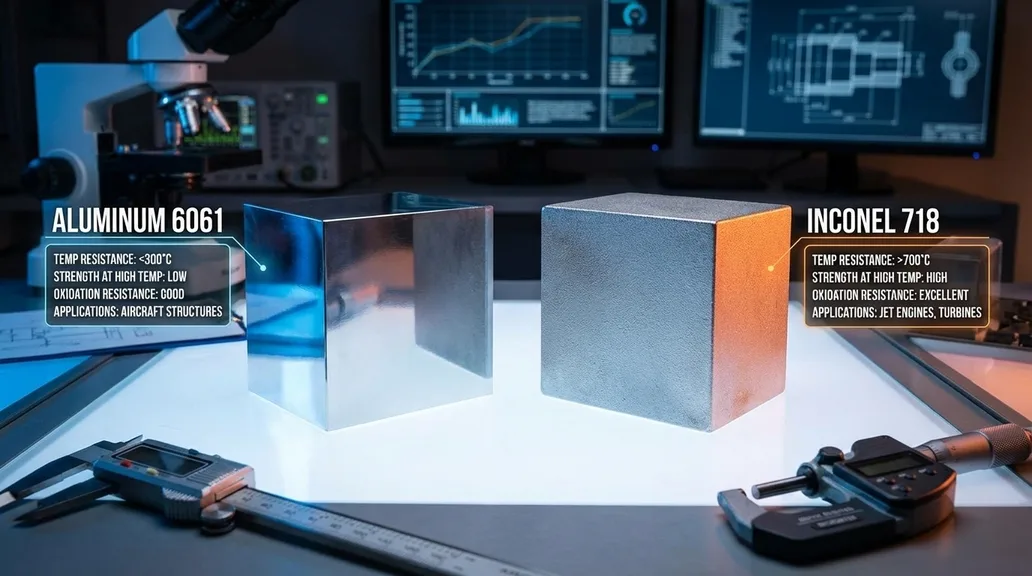
Yield Strength vs. Temperature: The 250°C Cliff
Inconel: The Superalloy Dominance
At extreme temperatures where aluminum fails, Inconel thrives. Its unique face-centered cubic structure allows it to maintain structural integrity at 700°C and beyond, where other metals would simply soften.
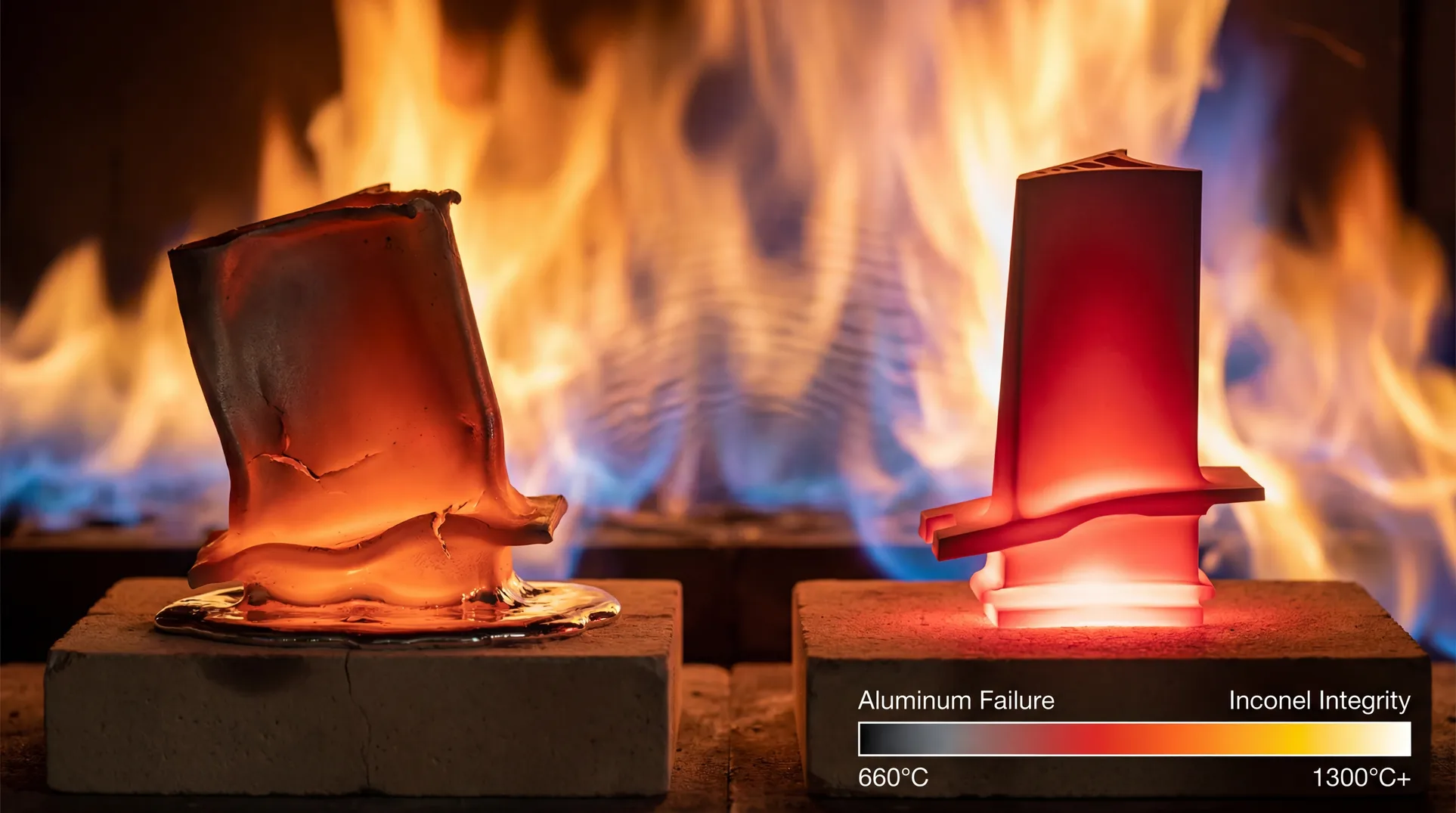
Extreme Conditions First: The Thermal Threshold
When a customer asks for “strength at temperature,” the first thing I check is the thermometer. Aluminum is a king of the low-to-mid range, but it has a “glass ceiling” that is physically impossible to break.
The 500°C Rule
Once you cross 250°C (482°F), most aluminum alloys start to lose significant tensile strength. By 500°C, aluminum is effectively “soft butter” structurally. Inconel (specifically grades like 718 or 625), however, doesn’t even break a sweat until it hits 700°C+.
- Creep Resistance: Inconel’s face-centered cubic (FCC) structure is engineered to resist permanent deformation under constant stress at high heat.
- Oxidation & Spallation: At 800°C+, Inconel forms a dense Cr₂O₃ (Chromium Oxide) layer. Unlike aluminum, whose oxide becomes porous at heat, or stainless steel, which suffers from Spallation (oxide flaking) during thermal cycling, Inconel’s skin stays anchored, protecting the core through thousands of heat cycles.
Jason’s Engineering Take
“If your part is going inside a jet turbine or a deep-sea oil well where 600°C and corrosive acids are the norm, stop looking at aluminum. You’re in Inconel territory now. But if you’re building a satellite bracket that needs to shed heat quickly and stay light, Inconel is a heavy, expensive anchor.”
Consult on Thermal DesignThe Grades That Matter: Choosing the Right Variant
Aluminum Variants
6061-T6: The All-Rounder
Excellent weldability and corrosion resistance. My go-to for structural frames that don’t face extreme stress.
7075-T6: The Strength King
Approaches the strength of some steels. Best for high-stress aerospace brackets where weight is critical but heat is low.
Inconel Variants
Inconel 625: The Corrosion Expert
Superior resistance to pitting and crevice corrosion. Used heavily in marine and chemical processing.
Inconel 718: The High-Temp Workhorse
Precipitation hardenable. Maintains incredible strength up to 700°C. The standard for jet engine components.
Property Reality Table: The Cold Hard Facts
| Metric | Aluminum (7075-T6) | Inconel (718) | Engineering Impact |
|---|---|---|---|
| Density (g/cm³) | 2.8 | 8.2 | Inconel is ~3x heavier. Critical for aerospace weight budgets. |
| Tensile Strength (RT) | 570 MPa | 1,100 – 1,400 MPa | Inconel is significantly stronger even at room temperature. |
| Strength at 600°C | Negligible (Fail) | ~900 MPa | Aluminum is unusable; Inconel retains most of its strength. |
| Melting Point | ~660°C | ~1,300°C | Inconel can survive environments that would melt aluminum. |
| Oxidation Resistance | Moderate (Surface only) | Extreme (Passivating layer) | Inconel handles hot corrosive gases (turbines/exhaust). |
| Cost Level | $ (Economical) | $$$$$ (Premium) | Raw material cost is 10x-20x higher for Inconel. |
| Machining Difficulty | Very Low | Extreme | Inconel requires carbide/ceramic tools and slow speeds. |
| Typical Industries | Robotics, Satellites, Consumer Tech | Jet Engines, Nuclear, Oil & Gas | Defined by the severity of the environment. |
Thermal Expansion Warning: The 23.5 vs 13 Disaster
One of the most common “rookie” mistakes I see is ignoring the Coefficient of Thermal Expansion (CTE) mismatch. When you mix Aluminum and Inconel in a single assembly, heat becomes your enemy.
-
AlAluminum CTE: ~23.5 x 10⁻⁶/K Expands rapidly and significantly.
-
InInconel 718 CTE: ~13.0 x 10⁻⁶/K Highly stable, expanding nearly 50% less.
Jason’s Assembly Disaster Report
“If you bolt an aluminum flange to an Inconel housing and cycle it from 20°C to 200°C, the aluminum will try to grow twice as much as the Inconel. This creates massive thermal stresses that will either pull the threads out of the aluminum or snap the Inconel bolts. In precision jet engines, this mismatch is a primary cause of seal failure and bearing seizure.”
DFM for Inconel: How to Stop Burning Money
The R1.5mm Rule
In aluminum, a tiny R0.5mm internal fillet is easy. In Inconel, it’s a death sentence for your budget. Never specify internal radii smaller than R1.5mm unless absolutely necessary. Small diameter tools lack the rigidity to cut Inconel and will snap instantly, doubling your cycle time and scrap rate.
Symmetry & Stress
Inconel has massive internal residual stresses. If you machine heavily on one side and not the other, the part will potato-chip (warp). Design for symmetry and avoid thin walls (< 2.0mm) to ensure the part stays within tolerance after it leaves the machine.
When Aluminum Fails: 3 Real Scenarios
The Turbine Exhaust Shroud
A client tried using 6061 aluminum for a prototype exhaust shroud. Within 2 hours of testing at 450°C, the mounting holes elongated due to thermal creep. The part vibrated loose, destroying the test rig. We switched to Inconel 625, and it hasn’t moved in 5 years.
Downhole Chemical Probe
In oil drilling, aluminum housing was eaten through by high-sulfur crude and brine in weeks. Pitting corrosion compromised the electronics. Inconel 718’s nickel-chromium base is virtually immune to this specific chemical attack.
High-Pressure Steam Valve
Aluminum lacks the fracture toughness required for high-pressure cycles. Under 3000 PSI steam, micro-cracks formed at the threads, leading to a catastrophic blowout. Inconel’s ductility at pressure prevents this sudden brittle failure.
When Inconel Is Overkill: The “Cost-Weight” Trap
I often have to talk engineers *out* of using Inconel. It sounds “sexy” and “indestructible,” but it carries a massive penalty in logistics and budget.
Low Temp Parts
Anything under 200°C rarely needs Inconel. Aluminum is 3x lighter and 10x cheaper.
Prototyping Speed
We can CNC machine 10 aluminum parts in the time it takes to finish one Inconel part.
Don’t use Inconel if:
- The operating temperature is below 250°C consistently.
- Weight is the #1 priority (e.g., drone frames, mobile robotics).
- There is no exposure to aggressive acids or salts.
- Budget is tight—aluminum 7075 can often provide enough strength for static loads.
Cost Drivers I See in Inconel Projects
Inconel isn’t just expensive because the raw nickel is pricey. The “hidden costs” come from the manufacturing floor. Here are the 8 drivers that blow up budgets:
1. Extreme Tool Wear
Inconel is an “abrasive” metal. It destroys standard carbide end mills in minutes. We use specialized ceramic tools.
2. Work Hardening
If the tool rubs instead of cuts, the surface becomes harder than the tool. This leads to broken cutters and scrapped parts.
3. Low Thermal Conductivity
Heat stays at the cutting edge instead of leaving with the chips. We must use high-pressure coolant to prevent melting the tool.
4. Slow Feed Rates
SFM (Surface Feet per Minute) for Inconel is often 1/10th that of aluminum. Machine time is expensive.
5. Stress Relief Cycles
Machining Inconel induces massive internal stress. Parts must often undergo vacuum heat-treat between operations to stay flat.
6. Material Price Volatility
Nickel prices swing wildly. An Inconel quote from last month might be 20% higher today.
7. High Scrap Value (and Risk)
A mistake on the final operation of an Inconel part can cost $5,000 in material alone. We run much slower to ensure 100% yield.
8. Traceability Requirements
Inconel projects almost always require full AMS/ASTM certification and X-ray testing, adding administrative cost.
Design Alternatives: The Hybrid Strategy
Localized Inconel Inserts
Don’t make the whole housing out of Inconel. Use an aluminum body for weight and heat dissipation, then use threaded Inconel Helicoils or custom bushings at the high-wear or high-heat contact points.
Thermal Barrier Coatings (TBC)
We can sometimes use high-strength aluminum (like 7075) with a ceramic or thermal spray coating to protect it from short bursts of heat, avoiding the weight of a solid Inconel part.
Buy-to-Fly Ratio & SLM
For Inconel, the Buy-to-Fly ratio (raw material weight vs. finished part weight) is a critical cost and ESG metric. CNC machining can waste 90% of a $2,000 superalloy block. We use SLM (Selective Laser Melting) to print near-net shapes, reducing waste by 80% while enabling complex internal cooling geometries.
Rapidaccu: Your Superalloy Partner
Whether you need the rapid turnaround of precision aluminum machining or the complex handling of aerospace-grade superalloys, Rapidaccu has the infrastructure to deliver.
Engineer’s Verdict: The Selection Rule
Scenario: Aerospace Structural Bracket
Internal fuselage component, operating temp -50°C to +80°C.
Recommendation: Aluminum 7075-T6Scenario: Combustion Chamber Liner
Direct flame contact, 900°C constant exposure, high thermal cycling.
Recommendation: Inconel 625 (or 718)Scenario: Marine Submersible Pressure Vessel
High depth pressure, extreme salt-water corrosion, 10-year service life.
Recommendation: Inconel 625 (or Titanium)Material Selection FAQ
What is the safe temperature limit for Aluminum?
Is Inconel stronger than Aluminum?
Can Aluminum replace Inconel to save weight?
Why is Inconel so difficult to machine?
Which is better for aerospace: Aluminum or Inconel?
What is the cost difference between the two?
Does Inconel rust?
Can you 3D print Inconel?
Optimize Your Material Strategy
Rapidaccu provides full-spectrum manufacturing for aerospace and energy leaders. From high-speed aluminum components to complex superalloy assemblies, our engineering team is ready to review your CAD files.
Engineering Inquiries
info@rapidaccu.comResponse Commitment
Technical Quote in 24h
About Rapidaccu
Based in the heart of global manufacturing, Rapidaccu specializes in CNC machining, sheet metal, and advanced material processing for mission-critical industries.
Request Technical Review
Upload your CAD files for an engineer-led quote