
Aluminum vs Titanium: When the Weight Savings Are Worth the Cost
Jack
15-Year Lead Engineer at Rapidaccu
In aerospace and robotics, “lightweight” is a mantra. But over 15 years, I’ve seen projects stall because they spec’d Titanium where Aluminum would have sufficed, or failed because Aluminum couldn’t handle the thermal stress. Choosing Titanium is a financial decision as much as a structural one.
Get a Technical Quote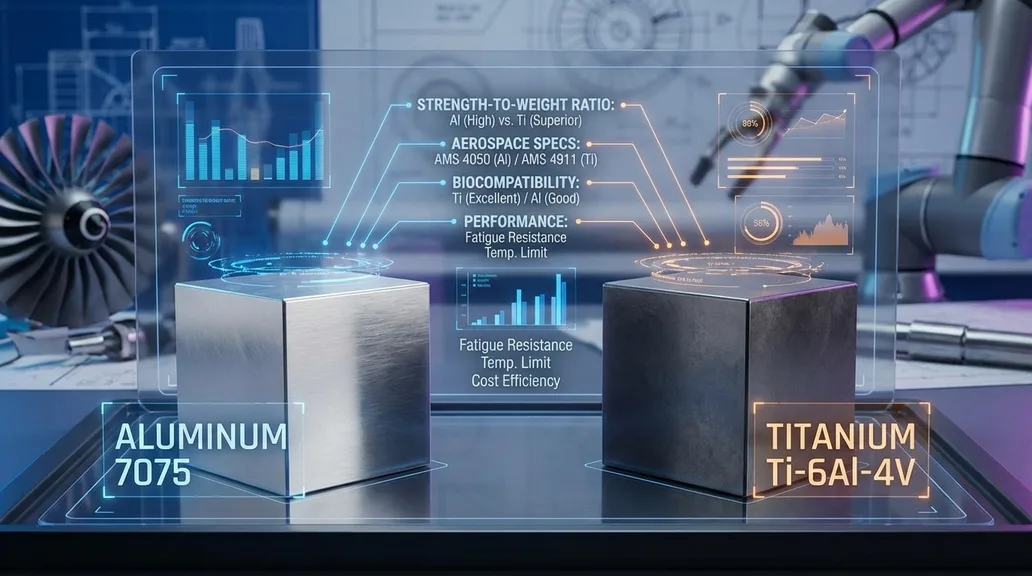
The “Worth It” Threshold
- If your operating temperature exceeds 150°C (300°F), Aluminum loses 50% of its strength. Titanium is now mandatory.
- For medical implants, medical grade titanium alloys (like Gr. 23 ELI) offer Biocompatibility and osseointegration properties that are unmatched.
- In aerospace titanium machining, if the weight saving of 1kg saves >$5,000 in fuel/payload over the lifecycle, Titanium pays for itself.
The Physics of Strength-to-Weight
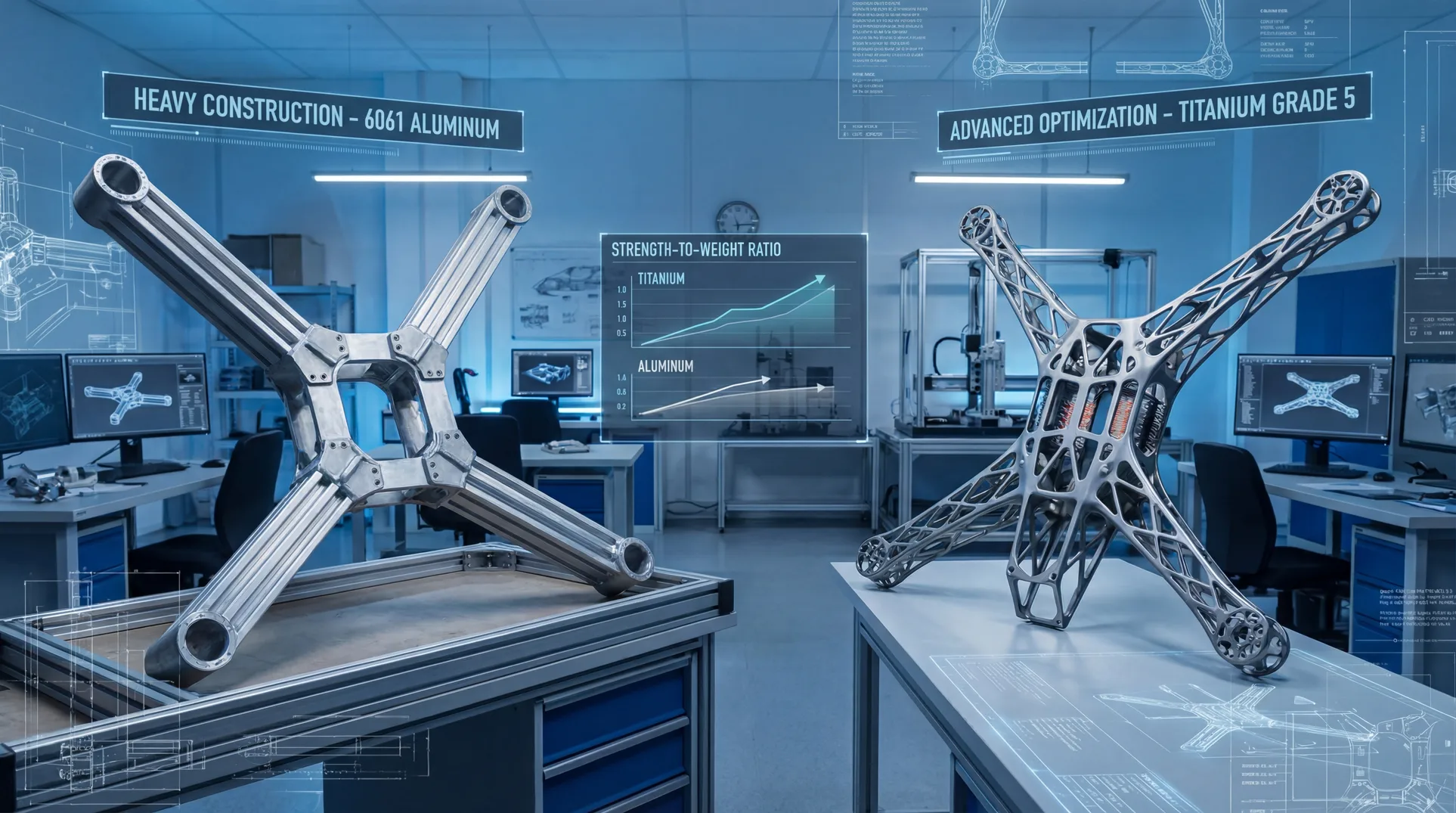
Titanium (Grade 5) is roughly 60% denser than Aluminum (6061-T6), but it is twice as strong. This allows engineers to design much thinner, more complex geometries that ultimately weigh less than a bulkier Aluminum equivalent.
“I often tell designers: Don’t just swap the material. If you switch to Titanium, you must redesign the part to take advantage of its higher modulus, or you’re just paying more for a heavier part.”
Cost Drivers: Why Titanium is a “Procurement Challenge”
1. Tooling Costs
Titanium is a “poor conductor of heat,” meaning heat builds up at the tool edge. Tool life is 1/10th that of Aluminum.
2. Cutting Parameters
Low SFM (Surface Feet per Minute) is required. Machining time can be 4x to 6x longer than Aluminum.
3. Material Removal Rate
High-speed milling isn’t an option. We have to “nibble” away, increasing machine-hour costs.
4. Internal Stress
Titanium parts “move” during machining. Multiple stress-relief cycles may be needed for thin-walled parts.
5. Surface Treatment
Color Anodizing (Type III) is a simple voltage-based process for identification, but Wear-Resistant (Type II) is a high-barrier specialized process.
6. Inspection Complexity
CMM inspection takes longer because of the tighter tolerances usually associated with Ti-grade parts.
7. Scrap Value Risk
A scrapped Titanium part at the final operation is a massive loss compared to an Aluminum equivalent.
8. Lead Time
Raw material supply for Grade 5 (Ti-6Al-4V) can be volatile, impacting your production schedule.
Jason’s Advice to Procurement:
“You can cut Titanium costs by 30% if you avoid deep internal pockets with small radii. Use larger corner radii (R>3mm) to allow for larger, stiffer tools. Also, keep wall thicknesses above 1mm unless absolutely necessary—thin walls in Ti are a machining nightmare.”
Precision & Stability: The Engineer’s Choice
Thermal Stability (CTE)
In high-precision optical instruments or Ultra-High Vacuum (UHV) environments, Aluminum’s high CTE (23.1 µm/m·K) causes significant thermal drift. Titanium (8.6 µm/m·K) is nearly 3x more stable.
Specific Stiffness (E/ρ)
While Titanium has a higher Modulus (114 GPa vs 69 GPa), its higher density means the Specific Stiffness is remarkably similar to Aluminum. The real advantage? Titanium’s strength allows for thinner, non-buckling walls.
Fatigue & Notch Sensitivity
Don’t be fooled by Titanium’s high fatigue strength. It is extremely sensitive to surface defects (Notches). A single deep machining mark from a worn endmill can reduce the fatigue life of a Ti-6Al-4V part by 40%.
- Aluminum (7075) requires high-quality anodizing to maintain fatigue life in corrosive environments.
- Titanium requires meticulous deburring and surface finishing to eliminate crack initiation sites.
The “Cost-to-Benefit” Analysis

Titanium Grade Selection Guide
| Grade | Type | Key Strength | Typical Use Case |
|---|---|---|---|
| Grade 2 | Commercially Pure (CP) | Highest Corrosion Resistance | Chemical processing, Marine heat exchangers, Medical (non-structural) |
| Grade 5 | Ti-6Al-4V (Alpha-Beta) | Highest Strength-to-Weight | Aerospace structures, Engine parts, High-end sports equipment |
| Grade 23 | Ti-6Al-4V ELI | High Damage Tolerance | Surgical implants, Orthopedic devices (ASTM F136) |
Application Recommendation Matrix
When to Choose Titanium
- Aerospace structural brackets (Engine adjacent)
- Orthopedic implants & dental screws
- Deep-sea exploration housings (Corrosion)
- High-end racing exhaust & suspension pivots
- Components requiring high fatigue life
When Aluminum is Better
- Electronics enclosures & heat sinks
- UAV/Drone frames (Cost/Weight balance)
- Prototype tooling & fixtures
- Large structural panels for non-aero use
- Low-temperature fluid manifolds
Hybrid Strategy: The “Middle Path”
Sometimes the best material isn’t just one—it’s a combination. Here is how I solve the cost-performance puzzle.
The “Core & Fastener”
Use Aluminum for the large structural body to save 80% on material costs, but use Titanium fasteners for critical joint strength and weight reduction.
Local Reinforcement
Design an Aluminum part with a press-fit Titanium bushing in high-wear points. This solves bushing clearance at high temperatures where Aluminum would expand too much, while maintaining local durability.
The Coating Alternative
If you only need corrosion resistance, consider Hard-Anodized or Ceramic-Coated Aluminum instead of full Titanium. It saves 70% on the final part cost.
2026 Shift: Additive Manufacturing (SLM/DMLS)
The biggest barrier to Titanium has always been the Buy-to-Fly ratio—buying 10kg of material to machine away 9kg. Metal 3D Printing (SLM/DMLS) changes the math.
Complex Geometries
Lattice structures and internal cooling channels that are impossible to CNC are now standard in Ti-6Al-4V 3D printing.
Cost Neutralization
For complex, low-volume Titanium parts, 3D printing is often cheaper than CNC because it eliminates expensive tooling and massive material waste.
Regulatory & Biocompatible CNC Machining
At Rapidaccu, we specialize in biocompatible CNC machining for the medical device industry. We understand that for Aerospace and Medical sectors, the Documentation is as important as the part itself.
- Material Certs (MTRs) with full traceability.
- 100% Dimensional Inspection Reports.
- Certificates of Conformance (CoC).
- Material Lot Tracking for safety-critical parts.
AS9100 & ISO 13485 Readiness
We maintain rigorous internal quality standards to ensure your Titanium components meet the strictest global regulatory requirements.
Request Certification SampleRapidaccu Manufacturing Solutions
Frequently Asked Questions
Is Titanium harder to machine than Aluminum?
Yes, significantly. Titanium’s low thermal conductivity and high chemical reactivity at high temperatures lead to rapid tool wear. It requires specialized coatings and rigid machine setups.
Does Titanium rust?
No. Titanium forms a stable, protective oxide film that provides exceptional corrosion resistance, especially in seawater and acidic environments where Aluminum would pit or corrode.
Can Aluminum be used for medical implants?
Generally, no. Aluminum ions are potentially neurotoxic. Titanium is the standard for long-term implants due to its bio-inertness and ability to bond with bone.
What is the cost ratio between the two?
Raw material cost for Titanium can be 10x to 20x higher than Aluminum. When including machining labor and tool wear, a finished Titanium part is often 5x to 10x the cost of an Aluminum one.
Is 7075 Aluminum as strong as Titanium?
7075 is one of the strongest aluminum alloys, but it still has only about 50-60% of the tensile strength of Grade 5 Titanium. Titanium also maintains its strength at much higher temperatures.
Can I weld Titanium to Aluminum?
Direct fusion welding is extremely difficult and usually results in brittle intermetallic compounds. Mechanical fastening or specialized friction welding are the preferred joining methods.
What is the lead time for Titanium parts?
Because of the slower machining speeds and specialized inspection requirements, Titanium lead times are typically 50% to 100% longer than for Aluminum parts.
Does Titanium require special surface treatment?
It depends on the application. For galling resistance, “Anodic Coating” is often used. For medical use, it is usually left in its natural passivated state or color-anodized for identification.
Ready for an Engineer’s Review?
Upload your aerospace or medical designs. Our engineering team, led by Jack, will provide a full DFM analysis and a competitive quote for both Aluminum and Titanium options.
Technical Inquiry
quotes@rapidaccu.comGlobal Manufacturing Hub
Shenzhen, China
Request Quote
Average response time: 2 hours